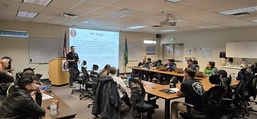
The Washington National Guard’s 10th Civil Support Team (Weapons of Mass Destruction) hosted a multi-agency Radiation Response Workshop, April 3, 2026 at Camp Murray, Wash., focused on bringing together federal, state, and local partners to strengthen coordination and readiness for radiological incidents.
The workshop brought together representatives from the FBI, the state’s Emergency Management Division,, Washington State Department of Health Office of Radiation Protection (ORP), and Department of Ecology. It focused on improving interoperability, information sharing, and response integration across agencies tasked with managing radiation detection and response events.
“This workshop is about building relationships before an incident happens,” said Maj. Ryan Dykes, commander of the 10th Civil Support Team. “When seconds matter, we rely on established trust and clear communication across agencies.”
The day’s agenda included a series of capability briefs from participating organizations, outlining each agency’s role in responding to radiological hazards ranging from industrial accidents to potential terrorist threats. Presentations highlighted the FBI’s lead role in weapons of mass destruction-related investigations under federal guidance, as well as the Department of Energy’s rapid-response capabilities and the Department of Health’s responsibilities in public safety and environmental monitoring.
A key component of the workshop was a tabletop exercise designed to simulate a small-scale, non-terrorist radiological incident. The exercise emphasized the flow of information between first responders and partner agencies, reinforcing coordination procedures and decision-making processes during real-world events. The exercise incorporated lessons learned from past incidents, including a 2025 State Route 16 response involving a damaged construction density gauge containing a cesium source. The case underscored the importance of early notification, proper standoff procedures, and coordinated communication among responding agencies.
“These real-world events that we experienced offer some incredible teaching points,” said Dykes. “We can always learn from each other and from our own experiences.”
Participants reviewed common radiological hazards, including soil density gauges widely used in construction, and discussed response protocols for damaged or compromised radioactive sources. Officials emphasized that while such devices are frequently involved in accidents, proper procedures and interagency coordination significantly reduce risk to the public. The workshop also revisited a real-world case study from a radiation contamination incident at Harborview Medical Center in Seattle, highlighting challenges such as delayed reporting and hospital readiness to receive contaminated patients.
“This discussion reinforced the importance of timely communication and public messaging during radiological emergencies,” said Dykes. “Knowing the partners and their capabilities is critical.”
Throughout the 10th Civil Support Team showcased its capabilities, including hazard detection, field analysis, and technical decontamination.
“Our mission is to identify hazards, assess impacts, and help decision-makers protect lives,” said Dykes. “Exercises like this ensure we are ready to respond alongside our partners at a moment’s notice.”