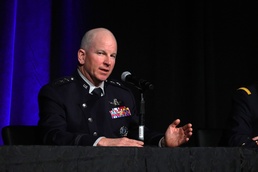
COLORADO SPRINGS, Colo.–U.S. Space Force Lt. Gen. Dennis Bythewood, commander of U.S. Space Forces–Space (S4S) and the Combined Joint Force Space Component commander for U.S. Space Command, provided a glimpse into the state of space warfare and integration efforts during a media panel at the Space Foundation’s 41st annual Space Symposium in Colorado Springs, Colo., April 15, 2026.
The panel, made up of three other space-centered senior military leaders from the U.S. and NATO, focused on the “Space Ops Theater Perspective” and how each respective commander was dealing with the challenges and opportunities in their areas of responsibility. The other panelists were USSF Brig. Gen. Brian Denaro, commander of U.S. Space Forces–Indo-Pacific; USSF Brig. Gen. Robert Schreiner, commander of U.S Space Forces–North; and French Air and Space Force Lt. Gen. Guillaume Thomas, the deputy commander of NATO Allied Air Command.
Bythewood framed the conversation by calling attention to the scale of S4S’s battlespace. With a charge to protect and defend the USSPACECOM area of responsibility while delivering global space-enabled effects to the Joint Force, the component field command has combat units and joint centers spread across the world that monitor both terrestrial and extraterrestrial activity.
“Our AOR starts at 100 kilometers and… moves out to infinity,” Bythewood said. “So the largest geographic AOR – not in the world, but in the galaxy.”
Recognizing such a vast scope of responsibility, Bythewood stressed the importance of Allies and partners, saying that “it’s fundamental to how we do business and understand what’s going on inside the space environment.”
Referencing the Joint Commercial Operations cell he said, “when we look at how to surveil all of the activity that’s going on in space and making sure that we can execute the missions that we’ve got… partners from around the globe allow us to do 24/7 operations and share an unclassified space domain awareness picture.”
Bythewood also cited Multinational Force–Operation Olympic Defender, which brings together the combined capabilities of the U.S., Australia, Canada, France, Germany, New Zealand, and the U.K., as an example of coalition space integration. United by a shared responsibility of collective security, these seven nations pool their space power to strengthen defense, deter aggression, and, if required, defeat adversaries.
“[MNF-OOD] brings together all the capabilities of those coalition partners to execute our missions around the world,” Bythewood said. “One [mission] is the space superiority mission that allows us to make sure that we can execute space operations at the time and place of our choosing, and then the other one is denying that same capability to an adversary.”
Two unique combined space operations were executed under the MNF-OOD banner. In late 2025, the U.S. and the U.K. conducted a first-of-its-kind bilateral rendezvous and proximity operation (RPO), which involve two satellites maneuvering closely together to perform military missions such as inspection, refueling, repair, or kinetic engagement. Shortly after, the U.S. and France completed a similar RPO.
This collaboration is part of USSPACECOM’s broader focus on 2026 being the “Year of Integration,” with a goal to forge a synchronized, agile, and combat-ready space enterprise that leverages all available domains and capabilities.
Bythewood highlighted the critical nature of “the teamwork that has to happen in order to make sure that we're able to support those terrestrial operations, and that those terrestrial warfighters can support the on-orbit operations,” he said. “We're bringing each of those individual space capabilities together to execute [USSPACECOM commander] General Whiting's mission.”
While conducting 24/7 space operations, S4S actively maintains a readiness posture to mitigate and counter threats. Bythewood shared how these have expanded as the domain has become increasingly contested by adversary actions.
“The threat regime has continued to grow for the last decades, whether it’s jammers coming from a base on the planet, anti-satellite weapons that would take out our capabilities on orbit, orbital satellites that are holding our assets at risk, and all of the cyber domain things that would hit our terrestrial-based infrastructure,” he said.
Bythewood insisted that combat forces need to practice like they play to succeed in this contested environment.
The USSF has been “training [Guardians] to execute within a combat arms kind of viewpoint. Where they’re always under threat… they have to adapt and identify how to move forward and execute their job,” he said. “The environment gets tougher every day.”
Bythewood concluded by highlighting the increased relevance of space in combat operations. Space effects have played a role in Operation MIDNIGHT HAMMER, Operation ABSOLUTE RESOLVE and Operation EPIC FURY, with U.S. Air Force Gen. Dan Caine, the chairman of the Joint Chiefs of Staff, singling out USSPACECOM as one of the “first movers” in the operation.
“Space as a warfighting domain has been established,” Bythwood said. “And the United States and its Allies and partners are working hard to make sure that we can contest that domain on any day, in any circumstance.”