PETERSON SPACE FORCE BASE, Colo. – Air Force Reservists at the 302d Airlift
Wing are stepping into a virtual world to enhance aircraft maintenance training.
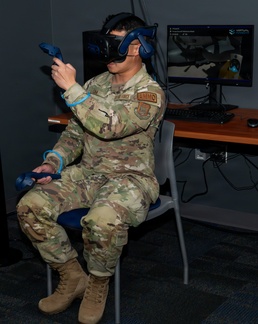
Inside the Maintenance Squadron's Extended Reality lab, known as the virtual hangar,
Airmen train on C-130 Hercules maintenance tasks using VR headsets and individual
hand controllers. The setup includes eight stations where Airmen can practice
everything from changing a tire to repairing cockpit instruments, repeating tasks as
often as needed while reducing wear and tear on real-world equipment.
“My favorite thing is seeing the Airmen’s reaction to the technology and how it builds
confidence before they even touch the aircraft,” said Dominique Dagohoy, the lab’s lead
and a quality assurance inspector.
The immersive modules allow Airmen to move around the aircraft virtually, from climbing
on top of it, inspecting inside the wheel wells and getting up close and personal inside
the aircraft with instruments inches from their face. All actions are performed from a
chair using hand controllers, giving Airmen a realistic sense of the task without the risk
of damaging the equipment.
The squadron has used the system for approximately two and a half years as part of the
Air Force’s Integrated Technology Platform, an initiative aimed to modernize training
across the force.
The technology accelerates training timelines by reinforcing task familiarity before
Airmen step onto the flightline.
“What used to take months and months to retain, now only takes maybe one or two
tries,” Dagohoy said. “It becomes muscle memory.”
For Reservists, who balance military duties with civilian careers, this system provides a
critical advantage by maximizing limited training time. By allowing repeated practice in a
controlled environment, Airmen can build confidence and proficiency before performing
tasks in real-world conditions.
Tech. Sgt. Tou Tswj Cha, a 302d AW munitions craftsman, said the system helps bridge
the gap between initial training and hands-on execution.
“It’s meant for training purposes, exposure training,” Cha said. “Then when you actually
go do the task, you’re familiar with it.”
More than 200 Airmen at the 302d have used the system, with approximately 60% of
the maintenance squadron completing modules.
According to Dagohoy, the program contributed to more than $19 million in cost savings
so far across participating units by reducing wear and tear on the equipment’s
components. The program provides a cost-effective way to preserve resources while
maintaining readiness.
The program is supported at over 135 bases, training more than 30,000 students
annually, with over 675 modules available across 31 aircraft platforms and nine ground
vehicles.
The system enables collaboration across installations by allowing units to connect
through the network and participate in shared training sessions.
The Air Force’s Integrated Technology Platform is constantly looking for ways to expand
and evolve. Dagohoy is part of a Spark Tank team exploring ways to make the program
more tactile and expand into more career fields like civil engineering and medical.
As the initiative evolves, it is expected to further strengthen readiness by ensuring
Airmen can perform tasks confidently and correctly when called upon.