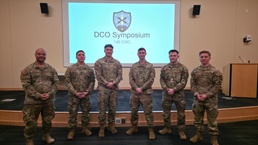
From April 10–12, 2026, the Connecticut National Guard hosted its first Defensive Cyber Operations (DCO) Symposium at Camp Nett, bringing together over 100 cyber soldiers from across New England to enhance readiness ahead of the upcoming Cyber Yankee exercise. The event marked the first time Connecticut has hosted a symposium of this kind, featuring participation from the 126th Cyber Protection Battalion and strengthening collaboration across New England cyber forces.
The three-day symposium focused on preparing cyber teams to execute defensive operations in response to evolving cyber threats. Participants included Army and Air National Guard cyber units, fostering joint interoperability and reinforcing a unified regional defense posture. The training directly supports preparation for Cyber Yankee, the National Guard’s premier regional cyber defense exercise.
The symposium commenced with a keynote briefing from Ian Leatherman of Microsoft, who emphasized the importance of adopting a zero-trust security model in today’s cyber environment. His presentation highlighted the growing sophistication of adversaries and underscored the necessity of continuous verification, least-privilege access, and resilient network architectures. This industry perspective provided attendees with valuable insight into current threat trends and best practices used across the private sector.
Following the keynote, experts from Palo Alto Networks Unit 42 delivered a threat intelligence briefing, outlining real-world attack methodologies and recent global incident trends. Their analysis provided cyber soldiers with a deeper understanding of adversary tactics, techniques, and procedures, enabling more informed and proactive defensive strategies.
A key component of the symposium was hands-on technical training led by 1st Lt. Hausmann of the 146th Cyber Warfare Company. During a Windows exploitation exercise, members of the 126th Cyber Protection Battalion explored common system vulnerabilities, including Discretionary Access Control Lists (DACLs) misconfigurations and Dynamic Link Library (DLL) hijacking. Soldiers not only learned how adversaries leverage these exploits but also practiced mitigation techniques to defend against them.
The training progressed to a focused session on using PowerShell for incident response. Participants developed skills in system auditing, threat detection, and automated response actions, capabilities that are increasingly critical in modern cyber defense. Mastery of tools like PowerShell enables cyber operators to respond rapidly and effectively to incidents, reducing dwell time and limiting the impact of adversarial activity.
Enhancing proficiency in exploitation analysis and incident response directly supports the National Guard’s mission in today’s complex cyber landscape. As cyber threats continue to evolve in scale and sophistication, these technical skills ensure that cyber soldiers remain agile, adaptive, and capable of defending critical systems and infrastructure.
Beyond technical development, the symposium played a vital role in strengthening cohesion among cyber units throughout New England. By training together in a battalion-level environment, Army and Air National Guard personnel built stronger working relationships, standardized procedures, and improved communication across state lines. This unity of effort is essential for coordinated responses during large-scale cyber incidents, such as those simulated in Cyber Yankee.
Beyond technical development, the symposium played a vital role in strengthening cohesion among cyber units throughout New England. By training together in a battalion-level environment, Army and Air National Guard personnel built stronger working relationships, standardized procedures, and improved communication across state lines. This unity of effort is essential for coordinated responses during large-scale cyber incidents, such as those simulated in Cyber Yankee.