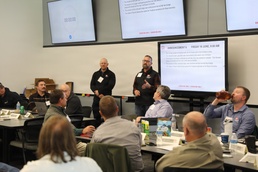
WILLISTON, N.D. — A tabletop exercise simulating a catastrophic levee failure and flooding emergency affecting the Williston, North Dakota area was held April 7, 2026, at the Williams County Emergency Operations Center.
The exercise, planned and hosted by the U.S. Army Corps of Engineers, Omaha District's Dam and Levee Safety Branch, brought together local, state and federal emergency managers along with law enforcement, public works officials, and stakeholders from the Williston area, to meet critical goals in emergency preparedness and flood response.
"You don't want the first time everyone's working together to be during an actual emergency," said Chad Sample, emergency management specialist for plans and training, Omaha District. "These exercises surface the gaps and build the kind of shared understanding that communities along the Missouri River near Williston are counting on us to have."
Briefings by the USACE team preceded the exercise on topics including the dam and levee safety program, reservoir and levee operations under normal conditions and during a flood event, and emergency action plans. Participants were reminded that levees and dams do not eliminate flooding, and that many agencies play essential roles in reducing flood impacts.
The exercise presented a developing, multi-day scenario beginning on a simulated Thursday evening in mid-June following an exceptionally wet spring across the upper Missouri River basin. Heavy snowpack had been melting rapidly through May and into June, driving historic inflows into the mainstem reservoir system. At the exercise's opening, the Missouri River and Little Muddy River were already running approximately halfway up the Williston Levee, with additional rain in the forecast for the Yellowstone, Missouri, and Little Muddy River watersheds.
The simulated scenario advanced in stages across five days, pressing participants through progressively serious conditions: relief wells showing signs of concern, boil activity along the levee, water rising to within two feet of the levee's crest, and ultimately a forecast of overtopping. By the exercise's final scenario announcements, the levee had failed at two locations, with floodwaters inundating portions of the city, stranding residents, and triggering rescue operations.
Throughout the exercise, participants were challenged with competing, time-sensitive demands that mirror real emergencies: a mayor requesting a briefing and advance materials as soon as possible, a college president weighing student evacuations, county emergency managers asking direct questions about levee failure, a governor calling for a joint press briefing, media crews arriving on-scene seeking interviews, and residents requiring rescue. Timed injects forced teams to prioritize, coordinate across jurisdictions, and communicate under pressure.
"Flood preparedness takes more than a good plan on paper," said Justin Messner, Disaster Recovery Chief, North Dakota Department of Emergency Services. "Exercises like this build the relationships and shared understanding between agencies that are hard to develop any other way. They put faces to names, increase awareness of each other's roles and responsibilities, and demonstrate what assistance we can offer each other when it counts most.”
There are more than 92,000 dams across the United States. The Omaha District owns and operates 28 dams throughout the Upper Missouri River Basin. The Williston Levee, located along the Missouri River in Williams County, North Dakota, provides flood risk reduction for the city of Williston and surrounding communities.
To learn more about dam and levee safety, visit: https://www.nwo.usace.army.mil/Missions/Civil-Works/Dam-and-Levee-Safety/.
Visit the National Inventory of Dams at https://nid.sec.usace.army.mil/#/ for additional information such as flood inundation maps for communities downstream of dams and levees.