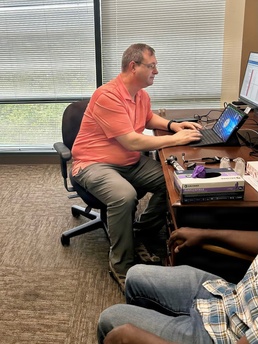
Dr. Brian Piltz has just recently settled into his role as Western Sector medical officer, but he has a perspective shaped by nearly two decades with USMEPCOM and a career path he describes as anything but traditional.
Before earning his medical degree, Dr. Piltz dropped out of college, worked as an auto mechanic, joined the Wyoming Army National Guard and spent time as a highway surveyor building and inspecting interstates. Eventually, he enrolled into the University of Wyoming for his undergraduate degree and then the University of Washington’s medical school where he found a passion for science and teaching.
“A lot of things in my path came to be useful in my roles at USMEPCOM,” he said. “Contracts, standards, diagnosing problems as a mechanic and even teaching.”
Piltz’s USMEPCOM journey began in 2009 as the Chief Medical Officer (CMO) at Fargo MEPS. After two years there, he moved to headquarters in North Chicago, serving as Battalion Support Branch Chief from 2011 to 2013, where he worked policy, credentialing and operational problem-solving. But he missed working at a small MEPS.
The opportunity to return to a small MEPS brought him to Alaska. While he was training a new CMO for Anchorage MEPS, the candidate backed out, leaving a gap at a critical time. He resigned as Battalion Support Branch Chief and took the job, beginning what became a 13-year tenure as Anchorage MEPS CMO.
During the COVID-19 pandemic, his wife was diagnosed with breast cancer. Although she is doing well now, the long-term effects of treatment played a role in where they could live comfortably. Because USMEPCOM is geographically dispersed, the opportunity to relocate wasn’t hard to come by.
“The chemotherapy left her with some physical problems that made Alaska winters not really compatible with us anymore,” he said.
After years in Alaska, Dr. Piltz returned to headquarters to serve as the Western Sector medical officer where his responsibilities range from operational support and staffing to mentoring leaders and helping MEPS navigate complex challenges.
“I think an important function of leadership is transparency and accountability,” he said. “And a willingness to get into the trenches and work.”
After 17 years with USMEPCOM, Piltz is clear about why he has stayed.
“I love it,” he said. “I want a job that means something and I found federal employment to be one of the best climates to have worked in. I have not met a provider that does not have a good attitude here.”
One area where Dr. Piltz’s enthusiasm is unmistakable is MEPS in a Box (MIAB). He has participated in seven pop-up operations, helping bring processing capabilities closer to applicants and recruiters. (Read more about MIAB here [https://www.mepcom.army.mil/Media/News-and-Press-Releases/Article-View/Article/4170140/usmepcom-launches-mobile-processing-with-meps-in-a-box/](https://www.mepcom.army.mil/Media/News-and-Press-Releases/Article-View/Article/4170140/usmepcom-launches-mobile-processing-with-meps-in-a-box/)).
“It’s one of the coolest things I’ve seen come along in our operational environment,” he said. “For years, Honolulu MEPS has taken the show on the road internationally across the Pacific to process remote islands. That underlying skillset has been modified to deploy domestically from within the mainland, taking our very skillful workforce to where recruiting demand exceeds the capacity of a local MEPS. It relieves the pressure on our colleagues at high demand MEPS, places the MIAB team directly in the center of high applicant concentrations and ends up developing new perspectives to take back to the MEPS.”
The Sector medical officer role has undergone refocusing since the Provider Quality Management Program Office (PQMPO) launched in Spring 2025. Operational problem solving, direct and remote support for execution of the USMEPCOM mission and collaboration with HQ and the field are where Dr. Piltz spends most of his time. (Read more about PQMPO here [https://www.mepcom.army.mil/Media/News-and-Press-Releases/Article-View/Article/4174527/usmepcom-centralizes-medical-oversight-with-new-office/](https://www.mepcom.army.mil/Media/News-and-Press-Releases/Article-View/Article/4174527/usmepcom-centralizes-medical-oversight-with-new-office/)).
“I’ve been using some mental models to find my way,” he said. “J-3 Policy is the Legislative Branch, Command Surgeon/ PQMPO is the Judicial Branch and Sector is the Executive Branch.”
As he settles into his role, Dr. Piltz says he is having fun. For a leader shaped by a scenic route, constant learning and a passion for the mission, that openness may be his most defining trait.
“I’m in a very learning moment right now,” he said. “And that’s fun. There’s lots of things to discover.”