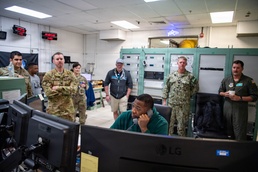
The group shuffles into the vestibule as the air-sealed door closes with a whoosh. They turn their heads to the opposite side of the crammed compartment to another door. U.S. Space Force Capt. Stephanos Rahimzadeh, commander of Combat Forces Command Mission Delta 31, 22nd Space Operations Squadron (SOPS); Detachment 3, reaches for a small metal flap and flips it up, acclimating his guests to the change in air pressure. Still, some experience a slight pop in their ears as the door swings open into the air-inflated radome.
Inside, normally hidden from its oversized golf-ball-like fabric shell, a large radar antenna is revealed. It sits atop a pedestal, silently pointing towards the sky, waiting for its target to come within its line of sight on the horizon. NASA’s Artemis II Space Launch System rocket carrying four astronauts had just launched from the Kennedy Space Center in Florida and was on its way into orbit. While the vehicle was launched at 6:35 p.m. on April 1, 2026, from the U.S., it would take less than 30 minutes for it reach the Indian Ocean, where it was the early morning of April 2.
Rahimzadeh beams as he turns to his guests of sister-service members from the Navy and Air Force. “We’re expecting to make contact with the launch vehicle and Artemis II soon,” he says.
Despite its remote location, the small team with 22 SOPS DET 3 satellite control ground station in Diego Garcia, also known as “REEF”, has an important role to play in the launch. The station acts as a crucial link in a global chain of satellite tracking stations, bridging a large communications gap over the Indian Ocean.
Rahimzadeh leads the group around the antenna. “Our team’s job is to make sure that we provide consistent telemetry data, like the vehicle’s location and other vitals, back to the Artemis II launch control center in Florida in the case that if something were to happen, good or bad, there is coverage to provide that information as its coming over this area.”
The radio in his hand crackles to life and a voice rattles off the time and approximate location of the incoming spacecraft. Rahimzadeh gathers his guests to the edge of the radome and everyone quiets down, watching the antenna attentively.
Suddenly the alarm blares throughout the radome and red lights spin. The antenna seems to suddenly awaken as if from a deep slumber and whirls around its pedestal, tilting its feedhorn into position towards the advancing rocket. Just as suddenly as it started the dish freezes, locking onto its target. The alarms fall silent, and the dish begins its slow, deliberate track, following the trajectory of the rocket as it positions to slingshot around the Earth on its way to the moon.
“This is a historic moment as this is the first time in over 50 years that human space flight is going back to the moon,” Rahimzadeh explains. “Despite that, we want this to be a very boring day for us since that means that operations are being conducted successfully.”
As the antenna tracks the rocket, the group works up a chatter and excitedly make their way back outside the radome to try and see if they can view the rocket’s path across the night sky. Once out in the early morning humidity they stand on the lawn and gaze up past the glowing giant ball of the radome into the night sky. Clouds have unfortunately blanketed the stars, even muting the moon’s powerful glow, and the band of stargazers are unable to see the shuttle. However, this doesn’t dampen any spirits as to what the group has just witnessed as humankind’s continued perseverance in space exploration. The success of this mission highlights the unique and vital role of the joint-force team in this lonely, quiet corner of the world.
“While this is such a remote location, our entire joint aspect and camaraderie here is absolutely fantastic!” Rahimzadeh says. “The ability to work and have such great hosts from the Navy, working in heavy partnerships with the Air Force, has been a huge enabler for us to continue successful operations that are so critical to the entire joint force, commercial entities, and exploration for humankind.”
As the shuttle passes beyond the antenna’s line of sight the group departs the radome and heads back to the main conference room to continue watching the live footage broadcasting from the SLS rocket.
Rahimzadeh reflects on this historic day in terms of both a career milestone and what it means to move forward.
“I feel super, super lucky to have been here at this point in time," Rahimzadeh says. "This is a once-in-a-lifetime opportunity. Because this has been going so successfully, it makes me look forward to Artemis III, Artemis IV, and all of our future operations even more.”
The 22nd Space Operations Squadron of Combat Forces Command’s Mission Delta 31 executes command and control of the Satellite Control Network by developing, executing, and enforcing the Space Access Tasking Order and providing space safety analysis to conduct satellite operations for more than 190 Department of Defense, Allied and national agency satellites. 22 SOPS operates and maintains seven remote tracking stations worldwide for the Satellite Control Network.