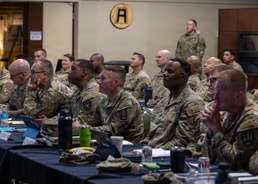
For the first time since the command’s activation ceremony as 3-star headquarters, U.S. Army Recruiting Command hosted leaders responsible for marketing, recruiting and training America’s best at the General George Patton Museum of Leadership April 16.
USAREC’s commanding general, Lt. Gen. Johnny Davis, addressed the leaders on the state of the command. He said the system that brings qualified applicants into the Army and turns them into American Soldiers formerly depended on multiple organizations that were not connected, but today one “family” works together to complete the process.
USAREC, long known as the command responsible for enlisted recruiting, aims to maintain that focus while expanding the command’s scope of responsibility. America’s largest service met its recruiting mission the last two years and is on pace to surpass its goal this year.
“Now, it’s all about precision,” said Davis. He added that while recruiting numbers increase each year, the force generation enterprise can now focus on niche requirements to fill specific high-priority jobs.
The enlisted recruiting mission now resides at U.S. Army Recruiting Division or USARD, led by Brig. Gen. Sara Dudley.
What makes USAREC different as a recently established 3-star headquarters is oversight of training for those entering the Army.
To accomplish this expanded role, USAREC absorbed the Center for Initial Military Training and has oversight of the Army Training Center – Fort Jackson, where roughly half the Army’s enlisted Soldiers begin their military journey in Basic Combat Training.
This oversight gives Davis and his new USAREC team responsibility of what he calls the Force Generation Pipeline. The pipeline starts with a potential recruit seeing a Be All You Can Be commercial or viewing the GoArmy website and ends with a trained Soldier reporting to their first unit of assignment.
Davis recognizes the need to keep the pipeline flowing.
“Even though recruiting has gotten better, what has happened throughout the force generation enterprise in the initial entry training base? Has that been improved?” he asked his subordinate commanders and senior enlisted leaders.
Davis then said increasing the number of recruits without ensuring the throughput at initial training installations can cause a backlog during that phase of the pipeline. To deconflict, he said USAREC must coordinate resourcing for the Army’s training bases.
As USAREC’s exact role in overseeing the Force Generation Pipeline continues to take shape, Davis said the command plans to ensure it has the right people in the right locations along with the facilities and accompanying systems in place to continue supplying the Army’s operational force with highly trained and qualified Soldiers.