On a warm and windy day in May 2022, two hostile drones, or unmanned aerial vehicles (UAVs), suddenly popped up above McMillan Airfield at Camp Roberts, California. An AquaQuad drone was quickly dispatched from the opposite end and, no sooner than it was in position, immediately launched an automated cyber-attack from 1,000 meters against the first drone, a Parrot Bebop 2. Defeated, it sank to the ground, a gust of wind flipping it over.
The team operating the counter-unmanned aerial system (C-UAS) next turned its attention to the second threat, a Skydio 2+ at 1,824 meters away. Another successful cyber-attack severed the connection to its ground station, sending the drone scuttling back to its point of origin.
These successful attacks were part of a technology demonstration of the Detachable Drone Hijacker (DDH), a small, low-cost C-UAS device attached to a UAV for aerial interdiction of enemy drones. Weighing 457 grams and consuming at most a mere 492 milliamps of power, the $250 DDH employs a de-authentication cyber-attack to target any adversarial UAS using the ubiquitous IEEE 902.11 wi-fi standard.
It also has the potential to flip the script on how the U.S. conducts C-UAS warfare.
“The way we fight against asymmetric threats must change, and I hope that the DDH helps change the narrative around drone defense and the protection of high-value units more broadly,” said U.S. Marine Corps Maj. Christian Thiessen, a Naval Postgraduate School (NPS) alumnus and co-inventor of the DDH.
“The U.S. builds extraordinary high-end platforms like the Ford-class aircraft carrier, F-35, or MQ-9. However, as we are seeing in the current wars in Iran and Ukraine, these high-end platforms are increasingly vulnerable to asymmetric attacks from distributed, low-cost, unmanned systems,” he continued. “Inexpensive one-way attack drones, like the Iranian Shahed, are having an outsized impact on the current war effort, and technologies like the DDH can help counter those threats in a scalable and cost-effective way.”
Working alongside his thesis advisor and co-inventor Dr. Britta Hale, at the time an associate professor in the NPS Department of Computer Science, Thiessen brought the DDH fully through the development cycle in a remarkable five years: inception, research, prototyping, field testing, thesis, patenting, and finally partnering with industry to get it in the hands of those who need it most – the warfighters of the United States military.
His is a unique success story, but not unique to NPS — where operational experience, education, research and industry come together for mission-driven, accelerated innovation.
“Maj. Thiessen’s accomplishments maximize the Marine Corps’ return on investment from the outstanding resources that NPS provides,” noted U.S. Marine Corps Col. Dana Demer, Senior Marine Representative at NPS. “NPS enables Marine students to tackle the Marine Corps’ most wicked problems, and is the perfect melding of warrior-scholars, top-notch academics, and industry partners.”
“Maj. Thiessen’s research has immediate operational impact and will save lives on the battlefield,” he continued. “Future Marine students will be able to build on Maj. Thiessen’s research and this is just one of many examples of the outstanding work here at NPS.”
The idea for the DDH was conceived in the summer of 2021 when Thiessen and Hale journeyed to Marine Corps Base Camp Pendleton, California, to participate in the Pacific Sentry 2021 field exercise held by I Marine Expeditionary Force (I MEF). They were piloting a new concept called the Fleet Engagement Program, which places NPS students and faculty in situ with operational units across the fleet and force to increase awareness between NPS researchers and practitioners in the field.
The engagement proved fruitful. Drawing on his own operational experience as an infantry officer and through conversations held with Marines in the field, Thiessen was able to identify a critical capabilities gap: a small, detachable system that can target the communication and control links of a target UAV via air-to-air cyber-attack methods.
“When I was a junior officer preparing for deployment overseas, the only counter-drone technologies we had were medium machine guns or shotguns,” he recalled. “That approach works in some situations, but it isn’t scalable and can also create significant collateral risk.”
By 2021, a profusion of C-UAS's had become available, but they were predominantly expensive ground-based, high-energy systems that relied on stand-off jamming. Thiessen and Hale wanted to change that paradigm.
During the Fleet Engagement Program, they began exploring whether there were more creative ways to approach the problem. The DDH grew out of those discussions as well as the idea that cyber and radio frequency (RF) techniques could provide a more precise way to counter unmanned systems.
“Britta and I both thought that there's got to be a better way to get around this,” Thiessen continued. “As we started spit balling and thinking about this a bit further, we realized that we’d have to design our own bespoke payload, but that payload would need to be agnostic enough that we could attach it to other drones.”
Upon returning to NPS, Thiessen dove head-first into this problem set; a remarkably interdisciplinary endeavor, requiring familiarity with aerospace engineering, mechanical engineering, systems engineering, electrical engineering, computer science, as well as radio frequencies, technical communications and offensive cyber methodologies.
All roads led to the construction of a DDH prototype. An elegant solution to a complex problem, the prototype consisted simply of a Raspberry Pi, a wireless network card and a Persistent Systems MPU5 wave relay radio.
The DDH’s watershed moment came on May 2, 2022, when Thiessen and Hale brought the prototype down to NPS’ Joint Interagency Field Experimentation (JIFX) program at Camp Roberts to test it out.
JIFX is NPS’ quarterly field event bringing together NPS faculty and students with private companies, federal partners, and academia to demonstrate and evaluate new technologies related to the U.S. Navy and DOW. Research is conducted in an austere field environment, providing the operational community with an opportunity to experiment with these technologies to better understand the capabilities they represent.
It was here that the DDH, attached to an AquaQuad drone, successfully knocked out the Parrot Bebop and Skydio 2+ above McMillan Airfield.
“JIFX was hugely important because it gave me unfettered access to range and airspace whereby I could fly drones and conduct RF-based offensive cyber-attacks without interfering with operations at another installation,” Thiessen said. “The range at Camp Roberts allowed me to maximize my experimental tests in an operationally relevant environment, which is something you simply cannot replicate in a lab environment. The freedom to test, iterate and refine the concept was core to the DDH’s development.”
With their successful prototype test in their rear-view mirror, Thiessen filed his graduate thesis, Redesigning the Counter Unmanned Systems Architecture, which charted a way forward for networked airborne squadrons of C-UAS devices such as the DDH to provide defense-in-depth aerial interdiction of adversarial UAVs.
He then graduated with a dual degree from NPS’ Applied Design for Innovation and Information Warfare Systems Engineering programs before moving on to his next assignment as a Service Chief’s Fellow at the Defense Advanced Research Projects Agency (DARPA).
Thiessen and Hale also began the process of filing a patent for the DDH. Filing a patent is a complex legal endeavor, overseen by the office of NPS’ Vice Provost of Research and Innovation. At NPS, skilled attorneys are integral members of the innovation team.
“The patent process is initiated by a submission from inventors to patent counsel in the Office of General Counsel,” explained Martin Carbajal, NPS patent counsel. “We review the submission and prepare a technical description of the novel aspects of the invention for the Invention Evaluation Board.”
The Invention Evaluation Board brings together key stakeholders, including the vice provost, the technical transfer program, the director of emerging technology, rotating subject-matter experts, and patent counsel. The board evaluates inventions based on novelty, mission relevance, and potential impact.
“If approved, patent counsel drafts the application using inventor interviews and technical materials and files it with the U.S. Patent and Trademark Office,” Carbajal said. “That process typically takes 18 months to two years.”
Thiessen and Hale’s patent, entitled Detachable Drone Hijacker and/or Jammer Method, Apparatus and System, was awarded to the duo on May 13, 2025.
“Receiving the patent for the DDH was an incredible honor,” Thiessen said. “More than anything, it validated that the research and experimentation behind the concept had produced something genuinely novel. It also reflected the collaborative effort behind the project. To me the patent represents the culmination of that research process and a foundation for others to continue building on the idea.”
It also unlocked the way forward to partnering with industry.
Innovation is core to the culture of NPS. Leveraging the intellectual, operational, and entrepreneurial talent of its students and faculty, the institution serves as a technology accelerator, incubator, and testbed for applications, concepts, and capabilities. Promising ideas are analyzed, war-gamed, red-teamed, and matured.
Central to this is NPS’ Emerging Tech & Innovation Office (ETIO), which promotes research innovation practices towards realizable products of value to the Navy and DOW. In coordination with the Office of General Counsel, it supports the development of formal agreements with industry partners, academia, and other external organizations, and provides NPS researchers with pathways to transition their work.
“At NPS, innovation doesn’t happen by accident—it’s built through the intentional combination of operational experience, academic rigor, and hands-on collaboration,” said Kaitie Penry, ETIO director. “That’s what allows students like Maj. Thiessen to take on complex challenges and turn them into real, actionable solutions. It’s a reflection of who we are as an institution, we value disciplined thinking, strong partnerships, and work that ultimately delivers for the warfighter.”
To wit, ETIO held NPS’ inaugural Reverse Pitch on July 23, 2025. The event had NPS innovators, including Thiessen, showcase their patented technologies to industry, investors and entrepreneurs with the goal of finding partners to commercially license their ideas “from lab to launch.”
“We believe that pairing real-world problems with cutting-edge research and strong private-sector collaboration is how we accelerate impact and solutions for national security challenges,” Penry said during the event, adding, “We’re proud of our presenters and the teamwork to make this event happen with our partners from Fleetwerx, the NPS Foundation, Techlink, and the NavalX Central Coast Tech Bridge,” which is now part of the U.S. Navy Rapid Capabilities Office.
The event was enormously successful. A win/win — the technologies on display were more than just concepts; they were grounded in operational needs, tested in demanding environments and built for dual-use defense and commercial applications.
“It was the first opportunity to pitch it as a core technology that you could build a company around,” said Thiessen. “From there, Kaitie connected me with the TechLink office, and from there I was connected with Robb Knie.”
Robb Knie, chairman of the American defense technology company America First Defense (AFD), immediately had his interest piqued by the DDH.
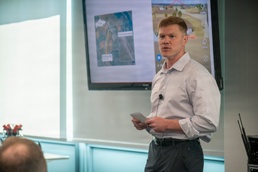
Thiessen walked him through how he originated the idea, how it was part of his thesis, how he went about designing it and where it stood in today’s small UAV space and counter-drone market, which is exactly what Knie was looking at.
“We’re spending lots of money trying to figure out how to counter the different drones that are in the sky and the different threats that are out there, both at home and abroad,” Knie said. “The only real systems that are out there use RF jamming, electromagnetic pulse, or obviously just brute force.”
“What Christian developed is so different, so unique and elegant,” he continued. “He uses a simple device that can be used with any type of drone as long as it has a place for a payload; it just chooses a cyber-attack, and the adversarial drones are disabled.”
Working with NPS’ ETIO and TechLink, AFD secured a licensing agreement for the DDH on March 5, 2026, positioning it to further develop and commercialize the scalable airborne C-UAS capability for defense, security, and critical infrastructure protection applications.
"Working with the licensing office and its team was a pleasure,” Knie said. “We were able to determine what steps were needed next to bring the inventors’ vision to light and make the DDH everything Christian thought it could be. We're building for America by America, and nothing says made and invented in America more than working hand in hand with the Naval Postgraduate School.”
As the DDH moves from concept toward real-world application through its partnership with industry, the people behind its development are also embarking on new chapters of their careers.
Thiessen is in the SkillBridge program on an industry internship, and Hale is now serving as director of post-quantum cryptography in the DOW’s Office of the Chief Information Officer.
“The DDH would not have been possible without the guidance of Dr. Britta Hale,” Thiessen said. “From our first conversation during the Fleet Engagement Program to the research, conference panels, and ultimately the patent process, she consistently pushed the project forward and helped set ambitious goals.”
Hale’s mentorship, Thiessen emphasized, was emblematic of a broader culture at NPS that brings together operational experience and technical expertise to drive meaningful innovation.
“NPS provides a rare opportunity for mid-grade officers to work with engineers and researchers on real operational problems,” said Thiessen. “Between the laboratory resources, access to the JIFX ranges, and technical experts like Dr. Britta Hale, I had an incredible support network. That combination of technical expertise and operational perspective made it possible to take the idea from conception to experimentation, and ultimately a patented design.”
Naval Postgraduate School (NPS) is located in Monterey, California, provides defense-focused graduate education, including classified studies and interdisciplinary research, to advance the operational effectiveness, technological leadership, and warfighting advantage of the naval service. Established in 1909, NPS offers master’s and doctorate programs to Department of War military and civilians, along with international partners, to deliver transformative solutions and innovative leaders through advanced education and research.