Darkness surrounded Airman First Class Steven Higdon, a hydraulic specialist in the 142nd Maintenance Squadron, as he stood waiting for the next challenge. It was 3:45 a.m. in the middle of the 48-hour-long Best Warrior Competition, and somewhere ahead, the next event was already set; he just didn’t know what it was yet.
This year’s Oregon Best Warrior Competition was hosted by the Oregon Army National Guard at the Camp Rilea Armed Forces Training Center near Warrenton, Oregon, March 19-21, 2026.Best Warrior is an Army National Guard competition, but in recent years, the Air National Guard has been invited to participate.
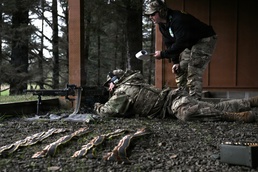
During this multi-day event, competitors were tested on their physical fitness, land navigation skills, marksmanship, and ability to handle other battlefield scenarios. These were showcased through physical fitness tests, review boards, rifle qualification, a three-gun competition, an obstacle course, and a 12-mile ruck march.
The succession of events throughout the 48 hours of competition was not random, but carefully designed to test how well competitors could adapt. With little rest, these Soldiers and Airmen moved from physical challenges to mental tasks with no notice. One moment, it was a long ruck through sand and water. Next, it was an essay due in a matter of hours, followed immediately by another physical event.
“It was an opportunity to just see how well I could do at all of the things that they asked us to do,” said Higdon. “I’m a naturally really, really competitive person… and I like to do as good at everything I do as possible.”
The competition brought together 21 participants from across the state of Oregon.
Best Warrior isn’t just about performance; it’s about stepping into something unknown and figuring it out in real time. To prepare for a competition of this caliber, participants train for months. For Higdon, having committed to the competition later than most others, training time was reduced to a mere five weeks. Luckily, Higdon’s already very active lifestyle of rock climbing, skiing, snowboarding, and more lent to his physical readiness to compete.
For the other aspects of the competition, there was no way to fully anticipate how the events would take shape. The structure is intentionally unpredictable, requiring participants to rely on instinct, training, and mindset rather than routine. To prepare as best he could, Higdon conducted his own research and worked with numerous individuals across the Oregon National Guard.
One of the more demanding moments came during a 12-mile ruck completed through difficult terrain. “It was an unknown distance ruck around Camp Rilea, including several miles on the beach, in the rain, through thigh deep water that began at [4 in the morning],” explained Higdon.
Even among a group of highly capable competitors, not everyone made it through every event. Of the 21 competitors, 15 finished the competition. Some participants, including those preparing to attend the U.S. Army Ranger course, were unable to complete portions of the event.
But even in an event built around individual performance, the experience, Higdon said, didn’t feel entirely individual.
“You’re with a group and motivating each other, even if it was the person that you’re directly competing with,” Higdon said. “Trying to drown out the, ‘I really want to slow down or quit’, or ‘maybe I’m not going to make it,’ because you got 12 miles, and you have to do it all in three hours…”
While each participant is ultimately responsible for their own performance, the shared difficulty created an unexpected camaraderie among competitors. They move together, push each other, and, at times, rely on one another to get through the more difficult portions.
By the end of the event, physical exhaustion is expected. Like many aspects of the competition, the result reflects more than just a ranking. It reflects the effort required to keep going, even without knowing what comes next.
Higdon emphasized that the experience wasn’t something he did on his own. Support from leadership, his shop, and others across the Oregon National Guard helped make his participation possible, including coordination with members at the 173rd Fighter Wing out of Kingsley Field Air National Guard Base in Klamath Falls, Oregon.
“The most gratifying aspect of this experience was proving to myself that even with a shorter preparation time, I could be competitive and could represent my unit with pride,” said Higdon. “I hate feeling unprepared, so I was honestly a bit nervous competing in the event. I had convinced myself that I would give it my 100 percent, but I wouldn’t be too critical of my performance if I fell short on some of the events. That made it even more rewarding when I took second!”
Through the 48-hour competition, Higdon not only proved something to himself, but also reflected the support of those who helped him get there.
“In three words, this event was unrelenting, grueling, and empowering,” concluded Higdon.
He plans on competing again next year.