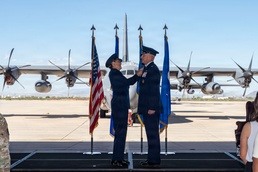
DAVIS-MONTHAN AIR FORCE BASE, Ariz. – The 11th Air Task Force was officially inactivated during a ceremony at Davis-Monthan Air Force Base, Arizona, April 17, 2026, marking the end of the unit’s mission after nearly two years of operations and a historic first deployment.
Maj. Gen. Leslie Hadley, mobilization assistant to the commander of Air Force Special Operations Command, presided over the ceremony. Airmen, families, community members and local leaders attended to recognize the unit’s service and contributions.
Activated under AFSOC in July 2024, the 11th ATF was established to develop and validate more flexible, mission-ready forces, particularly focused on Agile Combat Employment (ACE) concepts. Drawing members from across five main bases, the task force utilized an expedited, nine-month Air Force Force Generation (AFFORGEN) cycle, built to enable Airmen to train and exercise together before being operationally employed as part of a team. This was a change from how the Air Force has traditionally filled deployment billets, when Airmen were pulled from bases across the force and often didn't meet until they arrived downrange.
Over its 21-month activation, the unit operated across multiple locations, executed hundreds of hours of training and validated new concepts for force generation and deployment. Airmen deployed as cohesive teams, operated with limited resources and maintained mission effectiveness despite evolving requirements. The unit supported several large-scale exercises, executed multi-domain training and refined how Air Force units organize and operate in dynamic environments.
“This task force proved what mission-ready Airmen look like in practice,” Hadley said. “They operated in demanding environments, adapted to change and delivered when it mattered.”
The task force became the first of its kind to deploy in July 2025, executing a nearly six-month mission across the Indo-Pacific region, including operations in Saipan, Republic of Korea and Guam. While deployed, Airmen enabled fixed- and rotary-wing operations, integrated with joint and multinational partners and sustained operations in austere and rapidly changing conditions.
“Our mission changed while we were out there, and that gave us a chance to show how adaptable our Airmen are,” said U.S. Air Force Col. Brett Cassidy, 11th ATF commander. “They were able to adjust quickly and still get the job done.”
The 11th ATF also demonstrated how small, agile teams can generate combat capability across dispersed locations, reinforcing the Air Force’s ability to project power in contested environments and respond to changing mission demands.
“Your fingerprints are all over the next generation of expeditionary concepts,” Cassidy said to 11th ATF members during the inactivation ceremony. “The impact you’ve made will carry forward.”
11th ATF leaders also recognized the role of families and community members who supported the unit throughout its mission, enabling Airmen to remain focused and ready during high operational tempo.
“This unit succeeded because of the people behind it,” Cassidy said. “That includes the families who supported our Airmen the entire time.”
The ceremony included the formal reading of the inactivation order and the casing of the guidon, symbolizing the end of the unit’s service. However, while the 11th ATF is officially no more, the lessons learned and data gathered during its existence will continue shaping how the Air Force trains and utilizes forces for years to come, particularly regarding the implementation of the Air Expeditionary Wing 2.0 concept.
“What this team built and proved over the last two years matters,” Hadley said. “The impact of this task force will carry forward into future operations.”