By ADAM SIKES TACOM Public Affairs
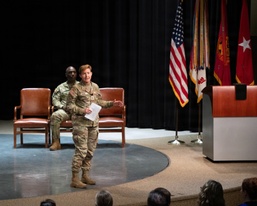
DETROIT ARSENAL, Mich. – Following up on her previous command-wide forums, Brig. Gen. Beth A. Behn, commanding general of U.S. Army Tank-automotive and Armaments Command, hosted a March 4 town hall with an eye on providing the workforce with strategic updates and addressing key quality-of-life concerns. The discussion with the workforce framed TACOM’s ongoing efforts within the new National Defense Strategy, which prioritizes "supercharging” the defense industrial base.
Here are four key takeaways from the latest TACOM town hall:
1. A "window of opportunity" for the Organic Industrial Base
Behn highlighted a "trifecta of alignment" between the U.S. presidential administration, Congress and industry on the need to invest heavily in the nation's defense manufacturing capabilities. The newly released National Defense Strategy highlighted the need to amplify investment in the nation’s defense industrial base – language that Behn said “sounds like a good news story for TACOM.” She described this as a critical "window of opportunity" for TACOM and its Organic Industrial Base.
“This moment will be fleeting,” Behn said. “I would charge all of us here at the headquarters and out at the depots and arsenals to be ready to seize the moment right when we have the opportunity and the direction to … go out and take advantage of these opportunities.”
Behn emphasized the “pace and urgency” with which she views the need for TACOM to transform to field readiness for Soldiers and their formations out in the field around the globe. Sharing a story from a recent trip to Europe to underscore the global impact of TACOM's work, Behn spoke of meeting with a U.S. cavalry squadron whose combat readiness serves as a major deterrent to adversaries like Russia. The squadron’s tanks and vehicles are directly serviced by TACOM installations and the specialized artisans employed by the command.
Behn said that she saw more than just Soldiers working in partnership with our allies:
“I see tanks being built at Joint Systems Manufacturing Center-Lima and overhauled at Anniston Army Depot,” she said. “I see main guns built at Watervliet Arsenal. I see Bradleys overhauled at Red River Army Depot. I see maintainers using tools … fabricated at Rock Island Arsenal. All the way down to the uniforms those Soldiers were wearing – hand-packed by somebody at Sierra Army Depot.”
She stressed to the workforce, "Formations like that have TACOM’s fingerprints all over them. The work you do here matters."
2. Transforming to better support the warfighter
Behn dedicated significant time to explaining how TACOM is adapting to a "once-in-a-generation acquisition system reform" sweeping across the Army.
“We are reforming our acquisition system with the sole purpose of delivering lethal capability to the warfighter faster,” she said.
This reform, which realigns Program Executive Offices under new Portfolio Acquisition Executives, emphasizes "baking in sustainment from the very beginning" of a program's lifecycle. The shift to PAEs will see the creation of Capability Portfolio Executive Ground, CPE Combat Logistics, Program Acquisition Executive Maneuver Ground and PAE Agile Sustainment and Ammo.
The changes, Behn acknowledged, have led to a lot of acronyms flying around amid the broader conversation about the Army’s efforts to transform and field lethality as rapidly as possible. Speaking to the takeaway for the workforce, Behn said that these reforms mean that the Army is addressing the long-standing issue of sustainment, specifically in that decisions about acquiring new capabilities will be made faster and that “corresponding sustainment for those capabilities will be baked into the process from the beginning.” Behn pointed out that the effect will be felt by the individual Soldier, alongside other initiatives like fielding the Soldier Equipping and Asset Management platform, to support readiness.
As a direct example of this Soldier-level focus for the command, Command Sgt. Maj. Kofie B. Primus highlighted the February 2026 launch of the new SEAM platform for all Soldiers everywhere in the Army. SEAM allows Soldiers to order the Organizational Clothing and Equipment they need and easily identify equipment they can offload to reduce burden. The platform directly tackles a common source of frustration by streamlining and digitizing the ordering piece of the Central Issue Facility process. SEAM allows Soldiers to view, manage and verify their equipment online in an experience that replicates online retailers that Soldiers use daily.
SEAM’s rollout was an Army-wide priority, according to Primus. He said the adoption of the platform across the force, including all three Army components, reflects the value that TACOM brings to the Army – having been designed, created and managed by TACOM personnel from its inception.
Primus went on to say that SEAM exemplifies TACOM's efforts to increase readiness and efficiency from the strategic industrial base down to the individual Soldier – with a specific eye on improving overall Soldier quality of life.
“A lot of what I do and deal with on a daily basis with the force comes down to OCIE,” he said. “Soldiers need equipment to go out and fight, and the team we have here at TACOM handles that every day – they’re great professionals.”
3. Renewed focus on quality of life
Responding to feedback from the previous year's Defense Equal Opportunity Climate Survey, the command team detailed specific actions being taken to improve the quality of life at the Detroit Arsenal. Behn and Acting Deputy Garrison Manager Bill Giezie outlined several projects, including adding more food service options, improving HVAC systems, increasing custodial services and installing new outdoor gazebos for employee use.
Behn’s focus on improving the quality of life has included hosting Commander’s Compass sessions with frontline employees. She said both she and Primus have gotten a lot out of the honest feedback sessions. The sessions also come as Deputy to the Commanding General Brian Butler hosts monthly sessions with supervisors around TACOM as another method to improve communication across the workforce.
Giezie also spoke about specific activities happening at the arsenal designed to make the in-person work experience more enjoyable. He pointed out that the new Detroit Arsenal unmanned marketplace has opened, soon to be complemented with new and expanded facilities for the popular Java Café coffee and quick service shop. The café will not only get a new, modernized facility in Building 270, but a satellite facility in Building 200 for TACOM’s sister tenant organizations.
The arsenal’s HVAC systems and fluctuating building temperatures were a common source of broader quality-of-life complaints, according to Giezie. He pointed out that since the DEOCS survey, the Detroit Arsenal has both implemented a new base operations contract and doubled budget share allocated to preventative maintenance for the arsenal to 30% of the garrison’s total budget. He also noted that since the garrison upped custodial efforts and resources following the return to in-person work, custodial maintenance complaints have dropped significantly.
“We know that we’re still in a growing stage as we adjust to changes in our work environment,” said Giezie. “But if anybody has a problem with the custodial services you’re receiving … make sure you reach out to your facility manager.”
He said facility managers will work with members of the workforce to ensure that employees receive the custodial quality they’re supposed to get, or receive an adjustment to the level of service in their area by working with the garrison’s Department of Public Works.
4. Heightened security and workforce vigilance
Behn also took the opportunity during the town hall to acknowledge the heightened security environment. She noted that while there is no credible active threat to the Detroit Arsenal or other TACOM installations, TACOM employees across the command could expect to see additional security and antiterrorism measures put in place to ensure workplace safety. Programs like the Trusted Traveler Program have been suspended in favor of enhanced security.
Leadership also addressed an increase in local drone sightings around the Detroit Arsenal. While most are attributed to legitimate commercial and emergency service operations, the workforce was reminded to remain vigilant and immediately report any suspicious drone activity to security.