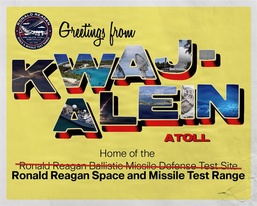
REDSTONE ARSENAL, Ala. — The U.S. Army Space and Missile Defense Command’s prime missile test site, formerly known as the Reagan Test Site, has been redesignated as the Ronald Reagan Space and Missile Test Range in the FY26 National Defense Authorization Act.
The Reagan Test Range, as it is also called for brevity, is a Department of War Major Range and Test Facility Base, located in the central Pacific Ocean on Kwajalein Atoll, Republic of the Marshall Islands. The facility conducts a variety of tests for customers across the DoW. Its redesignation reflects its historic role in space testing and in conducting space operations and space surveillance in direct support of U.S. Space Command.
“This name change is a fitting adjustment that underscores the diverse capabilities of the range,” Daniel Bryant, Director, Reagan Test Range said. “We do much more than missiles. Putting our space capabilities right there in the name brings recognition to the importance of our long-standing work in space that has occurred since the early 1980s.”
On top of the offensive and defensive missile testing capabilities RTR is known for, the range uses its highly capable radar sensors that are used to detect new foreign launches, to image and identify space objects, and share that data with U.S. Space Command. RTR not only contributes to defense of our nation’s interests in space but also serves a wide variety of scientific research and test missions, including support for all five Falcon 1launches between 2006 and 2009.
“The variety of missions we support makes RTR a fascinating place to work,” Bryant said. “We have flexible electromagnetic and safety constraints since we’re so isolated in the Western Pacific. RTR is a perfect place for space testing, orbital launches, hypersonic impacts, atmospheric research and tests for many other advanced weapons systems. Our test professionals are world-class.”
The range is operated by a team of Army personnel, government civilians, technical support contractors, and scientists from MIT Lincoln Laboratory.
The Pacific-based test range has several benefits to draw in customers from in and outside of the DoW, including its proximity to the equator to make orbital launches easier, and the ability to operate tests from the continental United States.
“[RTR’s] Range Operations Center is here in Huntsville, so they literally operate the entire range from here,” Bryant said.
While the RTR Operations Center-Huntsville is a hub for USASMDC’s space and missile capabilities, the command’s testing operations are not limited to that facility. A recent optimization within USASMDC’s Technical Center merged all test activities into RTR, expanding its reach beyond Huntsville and Kwajalein Atoll. One particular team in charge of SMDC’s wide variety of testing capabilities, can be found all over the world.
“Our personnel conduct missions across the globe,” Cain Crouch, chief of USASMDC’s Targets and Test Resources Branch said. “You can find our footprint in Kwajalein, Huntsville, Yuma Proving Ground, White Sands Missile Range, Cape Canaveral, Wallops Island, Vandenberg Space Force Base - pretty much anywhere in the world that test services are provided.”
From those locations, Crouch and his team’s testing capabilities operate within its five sections: ballistic missile targets; the Aerophysics Research Facility; Precision Track and Search Radar; Portable Range Operations and Test Network; and the Air and Missile Systems Integration Lab.
Reagan Test Range stands ready to support rigorous and realistic tests of all missile classes, intercept scenarios, as well as space operations.