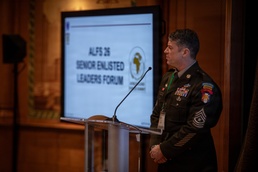
ROME — Senior enlisted leaders from Africa, Europe and the United States attended the Senior Enlisted Leader Forum, held in conjunction with the African Land Forces Summit in Rome, Italy, March 24.
Hosted by U.S. Army Southern European Task Force, Africa (SETAF-AF) and sponsored by the Office of the U.S. Army Chief of Staff, ALFS annually brings land force leaders together to strengthen partnerships and address shared security challenges. The SELF, introduced seven years ago, reinforces that mission by focusing on the critical role of noncommissioned officers in shaping future forces and driving mission success.
“Forums like this allow us to synchronize efforts of leader development from across the African continent while building relationships that matter,” said U.S. Army Command Sgt. Maj. Chad Harness, senior enlisted advisor for SETAF-AF. “As we execute our eighth iteration of SELF, this is the largest forum we’ve done, which only codifies its importance as we build upon the NCO corps.”
This year’s forum marked the first time the SELF took place in Europe. Harness welcomed participants and emphasized the importance of senior enlisted leadership in building capable, adaptive formations prepared for modern warfare.
“The theme of this year’s ALFS conference was innovation,” Harness said. “For innovation to become positive change it must meet the demands of the operational environment and practical application by the end user. For that to happen across our partner forces, we need strong NCO leadership like I see at this event.”
Reinforcing the importance of enlisted leadership in executing strategy, Italian army Command Sgt. Maj. Michele Romano underscored the role of NCOs in mission success.
“The most expertly thought-out plan is only as good as the NCO corps that is interpreting and executing it,” Romano said. “Our strength as armies comes from the professionalism, discipline and adaptability of our NCOs.”
Building on that perspective, keynote speakers such as U.S. Army Command Sgt. Maj. Paul Fedorisin, senior enlisted advisor for 7th Army Training Command, and U.S. Army Command Sgt. Maj. Joshua Peterson, senior enlisted advisor assigned to the 173rd Mobile Brigade Combat Team, highlighted how disciplined, well-trained NCO corps across multinational formations enable operational effectiveness.
“A strong NCO corps is the backbone of any effective force, especially in multinational environments where trust and standards must be shared,” Peterson said. “When we invest in our enlisted leaders, we are investing directly in readiness and mission success.”
The forum gathered experienced sergeants major and senior enlisted leaders who shared insights drawn from decades of service. Expanding on the keynote remarks, discussions focused on leadership, readiness and innovation, with participants exchanging best practices for training and managing forces in an increasingly complex operational environment.
Echoing these themes, senior enlisted leaders from African partner nations contributed to the dialogue by sharing how they maintain discipline while fostering innovation and adapting to evolving threats.
“We face many of the same challenges, but forums like this give us new ideas and approaches we can take back to our formations,” said U.S. Army Sgt. Maj. Andrew Johnston, Security Cooperation Directorate sergeant major for SETAF-AF. “There is nothing to say that a corporal in Zambia isn’t the one who develops a solution to a tactical problem threatening all of us. I have worked with dozens of militaries over the years, and the best partners all have the same thing in common: a strong and empowered NCO corps.”
Adding to the collaborative environment, U.S. Army National Guard participants engaged with counterparts through the State Partnership Program, strengthening long-term partnerships and supporting the advancement of enlisted development initiatives aligned with U.S. Africa Command’s African Enlisted Development Program.
“The State Partnership Program allows us to build lasting relationships that go beyond a single exercise or event,” Johnston said. “Through the SPP program, partner and U.S. NCOs can engage and grow with each other over decades as opposed to years, building real partnerships and showing the U.S. commitment to security cooperation.”
The SELF supports this broader effort by enhancing partner force capability to address regional threats independently or alongside U.S. forces.
Concluding the forum, leaders emphasized that open dialogue and shared experiences remain essential to building trust and interoperability among participating nations.
“The relationships we build here are just as important as the lessons we share,” Harness said. “They are what enable us to operate together effectively in the future.”
The relationships formed and ideas exchanged in Rome will continue to shape how senior enlisted leaders develop their formations, contributing to a more secure and stable future across Africa and the rest of the world.