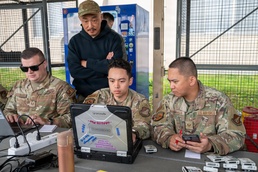
YOKOTA AIR BASE, Japan – U.S. Air Force Airmen assigned to the 374th Airlift Wing and partner units participated in Yokota Air Base’s first Radiant Falcon exercise April 13-16, strengthening their ability to recover, process and relaunch contaminated aircraft in a radiological environment while protecting personnel from hazardous exposure.
The scenario integrated bioenvironmental engineering, emergency management, maintenance, aircrew and other mission partners to simulate aircraft returning to Yokota after flying through a radioactive plume. The training focused on maintaining mission continuity while keeping radiation exposure within acceptable limits.
“Radiant Falcon gives us the framework to continue operations in a degraded or contaminated environment,” said U.S. Air Force Tech. Sgt. Patrick Houldridge, 374th Operational Medical Readiness Squadron noncommissioned officer in charge of readiness plans and training. “We track exposure, assess risk and give leadership the information they need to protect the force and keep the mission moving.”
Airmen established contamination control areas and executed aircraft recovery operations, including disembarking aircrew, unloading cargo, conducting maintenance inspections, refueling and preparing the aircraft for follow-on missions.
The exercise also incorporated simulated blackout conditions caused by an electromagnetic pulse, removing access to digital systems and communications. Airmen relied on manual tracking methods, paper forms and face-to-face coordination to maintain accountability and continue operations.
“In a real-world scenario, we can’t depend on technology,” said Houldridge. “This training ensures we can still execute and accurately track radiation exposure even if systems are down.”
Radiant Falcon reflects Yokota’s role as a key mobility hub in the Indo-Pacific. Yokota supports both cargo and passenger operations, increasing the complexity of managing contaminated aircraft and tracking exposure across a larger population.
“Yokota’s mission set requires us to think bigger,” said Staff Sgt. Tanisha Griffin, 374th Operational Medical Readiness Squadron occupational health NCOIC. “We’re not only recovering an aircraft, we’re managing passengers, cargo and multiple work centers, all while monitoring exposure.”
The training served as one of the first milestones in expanding the installation's ability to operate in contested and degraded environments. Similar training at bases such as Osan Air Base, South Korea, and Spangdahlem Air Base, Germany, has reinforced cross-functional coordination, manual operations and the ability to sustain airpower under hazardous conditions.
“Exercises like this ensure we’re ready for more than just routine operations,” Houldridge said. “No matter the environment or threat, Yokota Airmen must be prepared to generate airpower, protect the force and keep the mission moving.”