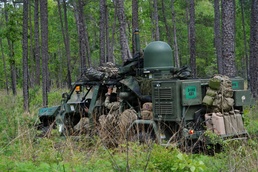
FORT POLK, La. — The 101st Airborne Division (Air Assault) took another major step toward Army transformation this month as Soldiers from the Multi‑Functional Reconnaissance Company (MFRC), 3rd Mobile Brigade, tested and trained for its first time with the Tactical Electronic Warfare System–Infantry (TEWS‑I) integrated onto an Infantry Squad Vehicle (ISV) during a Joint Readiness Training Center rotation, April 7–17, 2026.
The integration marks a milestone for the Army and the Division: TEWS‑I now mounted on the ISV, a lightweight, highly mobile platform designed for rapid air assault and distributed operations. According to General Dynamics Mission Systems, TEWS‑I on the ISV creates a “middleweight” electronic warfare capability—more powerful than man‑portable systems but lighter and faster than heavy vehicle platforms. F or Sgt. Javan Isaiah, an electronic warfare specialist (17E) and EW squad leader with the MFRC, the rotation was both a challenge and an opportunity.
“This was my first time using the system in the field,” said Isaiah. “We only had about three days of actual hands‑on time before coming out here, so a lot of what we learned came from troubleshooting in real time.”
Despite limited preparation, Isaiah said his team adapted quickly.
“EW Soldiers are critical thinkers. We’re used to new systems coming at us fast,” he said. “We had to learn the ISV and the TEWS‑I at the same time, but we figured it out together.”
Traditionally, electronic warfare systems have been mounted on heavier vehicles. Integrating TEWS‑I onto the ISV gives EW Soldier in light infantry units a new level of mobility and flexibility.
The ISV’s off‑road agility allows EW teams to reach better collection sites faster, reposition quickly, and keep pace with maneuver forces. Isaiah said the difference was immediate:
“Mobility across the battlefield in this modified ISV was a game‑changer compared to heavier vehicles,” he said. “We can be employed faster, we can air assault in with the ISV, and we can get to the right place at the right time.”
This directly supports the Army’s push toward mobile, distributed, multidomain formations, a concept the 101st has been helping test through initiatives like the Mobile Brigade Combat Team prototype and “Transformation in Contact.”
TEWS‑I gives commanders the ability to detect, identify, locate, and disrupt enemy signals—capabilities that are increasingly essential in modern warfare.
“There are enemies we can’t see who live in the electronic battlespace,” said Isaiah. “Our job is to find them, understand what they’re doing, and give the commander options to stop them.”
He described how TEWS‑I can locate enemy communications, direction find their location, and—when authorized—jam or degrade their ability to coordinate.
“If the enemy can’t talk, they can’t fight effectively,” he said. “That gives our infantry an advantage.” The 101st Airborne Division is known for speed, agility, and the ability to strike deep. Isaiah believes TEWS‑I on the ISV strengthens that legacy.
“The TEWS-I lives up to the air assault name by being a quick deployable fighting force,” he said. “It helps us stay ahead of near‑peer threats and operate in a multidomain environment.”
The system also supports the Army’s broader modernization goals, including integrating cyber, electronic warfare, unmanned systems, and sensing capabilities at lower echelons—an approach highlighted in the Army’s emerging multidomain effects formations.
For the 101st, the JRTC rotation demonstrated not just a new piece of equipment in their arsenal, but a new way of fighting—one that blends agility, sensing, and electronic attack into the fast-moving air assault formations the division is known for.
“We’re staying ahead of the learning curve,” Isaiah said. “That’s how we protect the force and stay lethal.”