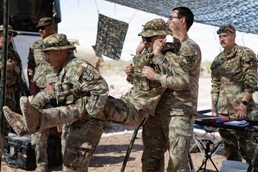
FLORENCE, Ariz.- Soldiers assigned to the 996th Medical Company Area Support (MCAS) conducted tactical medical training for both combat medics and Soldiers to strengthen readiness and combat effectiveness by practicing rapid, lifesaving care.
The training focused on Tactical Combat Casualty Care (TCCC), a critical skill set that allows combat medics to treat injuries and return soldiers to safety in high-risk environments.
“We’re focusing on care under fire, tactical field care,” said Sgt. Elexsus McGregor, a combat medic with the 996th MCAS. “If we end up getting deployed, we want to make sure that we’re ready to handle as much as we can…making sure that we are properly trained up and that we are taking care of people.”
Soldiers are trained on essential battlefield skills such as applying tourniquets, moving casualties from danger zones to cover and providing prolonged field care. These scenarios replicated real combat conditions, strengthening muscle memory and decision-making under stress.
“As a combat medic, we are required to know a lot…Out on the line, we might be the closest thing to a doctor,” McGregor said. “We are required to know as little as scrapes, bruises, headaches, all the way up to massive hemorrhaging, life-saving skills, making sure that we can take care of people out in the field.”
The training followed a crawl-walk-run methodology, allowing soldiers to fully practice each step before executing full-scale scenarios.
“The lowest level of knowledge is exactly what you fall back to when you’re in a stressful environment,” said Spc. Kennedy Duong, a combat medic assigned to the 996th MCAS. “If you haven’t practiced enough, then Soldiers are going to die. That is the reason that we are practicing the way that we do, to maintain our readiness.”
TCCC training prioritizes battlefield care in harsh environments, where medics might rely on limited resources. This type of training ensures Arizona Army National Guard Soldiers remain capable despite reduced training time compared to active-duty soldiers.
“We focus on quality over quantity,” Duong said. “This is the closest we get to a deployment environment. The need to practice all the time is so that you can perfect those lowest levels, and just always have something ready to go.”
Combat medics can have different roles, from ambulance support to establishing aid stations or embedding directly with infantry units. Across all missions, the ability to provide immediate, effective care remains essential to sustaining operations.
“Training really is everything,” McGregor said. “It can be tedious, and it absolutely is hard, but one day this isn’t going to be training, this is going to be real life. And, the more we train, the better we can succeed in real life.”
Through continued repetition and training, the 996th MCAS reinforces readiness among Soldiers, ensuring they remain lethal and effective on the battlefield.