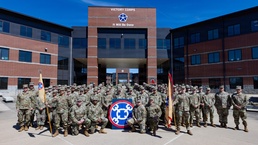
Annual training is intended to provide realistic simulations or real-world scenarios and, at times, support real-time ongoing operations. Observer Coach Trainers (OCT) got it right for their training audience,providing coaching, mentoring, and real-time feedback toSoldiers of the 310th HHC.
These training events refine and assess the unit's ability to operate in the most difficult scenarios it may encounter in a battlespace. Soldiers of the 310th Headquarters and Headquarters Company conducted their annual training working with the V-Corps in multiple locations in the EUCOM theater, and at the V-Corps headquarters in Ft Knox, KY, during the month of March.
From 2-28 March, Soldiers of the HHC worked together with members of the V-Corps through a Command Post Exercise (CPX) and the Warfighter 2026 exercise, often working in excess of 14-hour days to see the missions through to successful execution. Soldiers have since returned home and have had time to reflect on the rigorous exercise. Read about their experience below:
Pfc. Wyadtt M. Strawmyer / MOS: 35F Intelligence Analyst
This was your first annual training; what are some key takeaways, and what would you tell Soldiers preparing for their first AT? Pfc. Strawmyer: “Definitely learn the systems—especially things like MAVEN. I didn’t know it beforehand and had to learn on the fly. Also, get to know other sections. I had never worked with Protection before, but they were extremely important during AT. At times, I had to go over and talk to them to better understand what was going on. I really liked interacting with my other counterparts from the fifth core.”
So, cross-communication is essential? Pfc. Strawmyer: “Yes—very much.”
Did you enjoy AT? Pfc. Strawmyer: “In hindsight, yes. Some parts were fun, and it was great training. It was valuable to do my job outside of a TRADOC environment and see what it’s really like. I enjoyed meeting new people, especially within Intel. You can learn a lot from more senior personnel and counterparts in other units.”
Do you feel like you chose the right MOS? Pfc. Strawmyer: “Absolutely. I love Intel—I knew that’s what I wanted when I enlisted.”
Pfc. Strawmyer is currently seeking to continue his education, potentially in mechanical engineering, with aspirations to someday work for a major defense contractor in his civilian capacity and possibly transition into the Warrant Officer Corps in uniform.
Spc. Victoria H. Webber / MOS: 35F Intelligence Analyst What was your experience at AT? Spc. Webber: “I really enjoyed it. During the warm-up, we built all of our product shells. We built everything up and started networking with everybody who was forward, sitting in Germany, as well as the fifth core. We met with the OIC, the warrant officer, and then the NCOIC in the Current Operations Information Center (COIC). After that, I was running pretty much back and forth with them in the Analysis & Control Element (ACE) lab. I also had to meet with their CW4. We worked pretty much hand in hand the entire time. They were also my sanity checkers because we were looking at the same areas for these products, so we regularly got together to compare notes.”
It sounds like you were being proactive. Spc. Webber: “Yes. I tried to anticipate what leadership needed before they asked. I built contact lists and ensured the next shift had everything they needed to succeed.”
What advice do you have for Soldiers entering service, or those who may be on the fence about joining? Spc. Webber: “I 100% recommend going to Intel. I love my job.” “The Army Reserve gives you opportunities—tuition assistance, career paths, networking. Use those resources. Also, build relationships. If you don’t know something, someone else does. The Intel community is small—you’re always connected.”
“Intel offers a lot of variety—you can work on fast-paced missions or long-term analytical products like white papers. You’re not locked into one role.”
“The Army is what you make of it. Use your resources, build relationships, and take initiative.”
Spc. Webber works full-time as an analyst and defense contractor for the Air Force and plans to reenlist and pursue a commission through either ROTC or OCS. She is interested in continuing both strategic and operational-level work.
Spc. Jimmie Taylor / MOS: 35F Intelligence Analyst
Spc. Taylor volunteered to attend MAVEN system training prior to the exercise to aid the HHC in follow-on training to support the mission.
“The most interesting feature I discovered was the ability to integrate interactive maps into a brief. I also appreciated the efficiency of being able to pull one workshop into another with just a few clicks.
“The MAVEN training significantly improved my ability to support my section with briefings. Because all briefs were housed within my main workshop, I could access and edit any slide within minutes to incorporate near real-time feedback from the team.”
“My initial MAVEN training was exploratory and focused on experimenting with personal projects. In contrast, the CPX exercise was heavily focused on establishing a knowledge management framework and creating a routine for briefs. This involved a period of trial and error as we learned to coordinate multiple users editing the same project; we eventually minimized the number of active editors to ensure work was saved correctly. During Warfighter, our focus shifted primarily to the visual presentation of the slides and ensuring map accuracy.”
Advice for New Users: “I recommend being willing to experiment and create your own projects. You learn the system best by staying curious and setting personal goals to improve your work. I personally became interested in MAVEN because it felt similar to Python logic. By treating it like learning a programming language—setting small goals and finding ways to optimize tasks, such as utilizing the custom map widgets from V Corps—I was able to better master the system.”
Maj. Nicole B. Palomino / 90A Logistics Officer “Working as a 310 ESC Future Operations (FUOPS) Officer with V Corps during the recent Warfighter Exercise was an intense, 24/7 immersion into large-scale combat operations. The experience was defined by a cycle of wargaming, anticipating the enemy's moves, and positioning our forces for decisive action. I managed and facilitated the 310 ESC operations synchronization meeting with other warfighting functions and subordinate units, focusing on the 72-96 hours ahead of the current fight. The pressure was immense, but the exercise provided an invaluable opportunity to refine our planning processes and ensure 310 ESC sustains the fight while providing the V Corps Commander freedom of maneuver.”