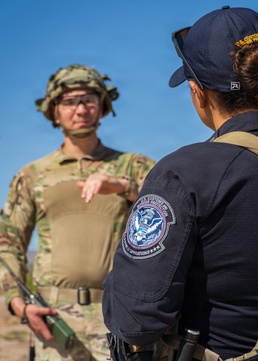
EL PASO, Texas – U.S. Army Soldiers with various units assigned to Joint Task Force-Southern Border (JTF-SB) took part in a Counter-small Unmanned Aerial System (C-sUAS) training operation alongside U.S. Customs and Border Protection (CBP) at Fort Bliss, Texas, April 9, 2026.
The rising prevalence of drones is a critical focus for JTF-SB operations in defense of the U.S. southern border. U.S. Army Capt. Zyan Limardo, of the 129th Division Sustainment Support Battalion, 101st Sustainment Brigade, 101st Airborne Division, assigned to JTF-SB, led the training operation and discussed its scope.
“We wrapped up a major joint operation focused on countering small drone threats along the southern border,” said Limardo. “We had personnel from Border Patrol, Air and Marine Operations, and the Office of Field Operations working hand in hand with our military teams, all involved in the Joint Task Force.”
The purpose of the exercise is to increase border security through awareness of how drones respond to counter-drone technology. The task force was demonstrating the use of their wearable drone jamming technology, known as “Wingman and Pitbull.” The “Wingman” device is used to identify a drone’s location in flight, while the “Pitbull” device is used to stun and stall the drone and disrupt the drone operator’s video feed. The concept is useful for small, mobile units operating in environments where they must quickly neutralize aerial threats.
CBP agents operated larger mobile jamming equipment catered toward locational security during the training. This collaborative environment sparked valuable information sharing, highlighting pathways for greater technical integration while strengthening partnership and capacity building between CBP and JTF-SB.
“For the Joint Task Force-Southern Border, the main goal was to boost our operational capabilities and make sure we’re sharing information with the agencies we operate with,” said Limardo. “Teaming up directly with U.S. Customs and Border Protection was very valuable. It created a collaborative environment with great dialogue and really strengthened our overall understanding of the mission.”
Drone use is becoming more prevalent in modern warfare. When asked about the military's evolving approach to drone technology, Limardo was direct.
“To enhance the effectiveness of our drone operations, we are focusing on a multifaceted approach that emphasizes shared understanding, comprehensive training, and the widespread integration of both small Unmanned Aircraft Systems and Counter-small Unmanned Aircraft Systems capabilities across all personnel,” Limardo said. “As the use of drones becomes more widespread, the knowledge of how to operate and counter them can no longer be confined to specialized units. The responsibility for C-sUAS must be a combined arms effort, performed down to the lowest level.”
The training operation directly supported the southern border mission by familiarizing personnel with emerging drone capabilities. U.S. Northern Command is working side-by-side with the Department of Homeland Security and U.S. Customs and Border Protection within narrowly defined authorities to provide unique military capabilities to protect the territorial integrity of the U.S. southern border.