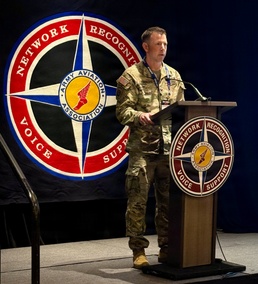
Col. Kevin Consedine, commander of Corpus Christi Army Depot, highlighted the scale, history and future of CCAD during an Industry Day presentation at the AAAA Warfighting Summit, emphasizing the depot’s central role in Army aviation sustainment and its growing partnerships with industry.
Maj. Gen. Lori Robinson, commander of the U. S. Army Aviation and Missile Command, opened the session by framing it as an opportunity to strengthen ties between the Army and private sector partners. She also encouraged attendees to engage directly with depot leadership.
“Thank you for being here to see what CCAD has to offer,” she said. “We invite you down to see the depot in person and continue the conversation.”
She noted that representatives from across the Army enterprise were present, including Army Materiel Command, contracting officials and industrial operations teams, to help answer questions and facilitate future collaboration.
Calling the event a starting point, Robinson emphasized the Army’s intent to build lasting partnerships.
“We know this is a first step,” she said. “We look forward to future dialogue.”
Robinson introduced Consedine, who began with a brief history lesson, noting the depot’s deep roots in South Texas and its upcoming milestone.
“This June, we’re coming up on a pretty significant milestone as an organization,” he said. “This will be the 65th anniversary of the Corpus Christi Army Depot.”
Established in 1961 along Corpus Christi Bay, the depot operates as a tenant unit on Naval Air Station Corpus Christi — a unique arrangement within the Department of Defense. Consedine said the location traces back to World War II-era naval aviation maintenance that helped establish a lasting industrial base in the region.
“This is more than just a depot,” he said. “The depot is woven into the DNA of our city,” describing a workforce that often spans multiple generations of families.
Today, the depot employs nearly 2,100 personnel across more than 170 acres and nearly 3 million square feet of production space. Consedine described it as the Army’s “center of gravity for all things aviation sustainment” and the only Center for Industrial and Technical Excellence in the Defense Department dedicated specifically to rotary-wing aircraft, with an emphasis on rotary weight sustainment.
He detailed the depot’s end-to-end aviation capabilities, from structural repair and wiring to full aircraft assembly and test flights.
“We can literally build a brand-new helicopter at the depot,” Consedine said. “It is absolutely an in-house production process from beginning until we deliver it to a unit.”
Among its key capabilities, he highlighted composite repair, advanced diagnostics and a rare level-two ball bearing reclamation program — a critical function in a supply chain often constrained by parts shortages.
“Bearings are one of those things that’s historically a constraint in aviation production,” he said. “That’s a really asymmetric capability that we have at the depot.”
Consedine also pointed to emerging technologies, including advanced non-destructive testing and a newly fielded inspection system that can identify structural issues in minutes instead of hours.
“We’re not guessing when something comes to the depot,” he said. “We are validating with scaled lab analysis.”
Much of the presentation focused on modernization efforts, including a large-scale aviation multipurpose production facility designed to centralize operations and improve efficiency. Once complete, the facility is expected to reduce internal movement of parts and materials by up to 70%.
“This is about efficiency and productivity,” Consedine said.
He emphasized that while the depot maintains and repairs aircraft, its primary workload is component sustainment — a critical factor in overall readiness.
“Components are ultimately what drive Army aviation readiness,” he said. “We never ran out of helicopters, but we sure got short on parts.”
Consedine also underscored the depot’s relevance beyond the military, citing commercial applications in areas such as corrosion control, advanced manufacturing and storage capacity.
“We are not just maintaining legacy equipment,” he said. “We are building forward.”
A key theme of the briefing was partnership. Consedine outlined multiple pathways for industry collaboration, including direct support agreements, work-sharing arrangements and leasing opportunities, stressing that the depot’s role is to complement — not compete with — private sector capabilities.
“When you partner with the depot, you’re not just partnering with us,” he said. “You’re partnering with the Army.”
He added that the depot can move quickly to establish agreements when requirements are clearly defined.
“We’re not talking years — we’re talking weeks or months,” Consedine said.
Closing his remarks, Consedine framed collaboration as mutually beneficial, providing industry access to skilled labor and infrastructure while helping the Army reduce costs and increase efficiency.
“The idea is we’re trying to create environments where everybody wins,” he said.