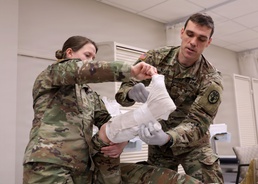
FORT DRUM, New York – For the Soldiers of the 10th Mountain Division (LI), peak physical performance is a prerequisite for the mission. But the same grit required to navigate alpine terrain and high-tempo operations often comes at a steep physical cost.
When "Mountain Tough" meets the reality of musculoskeletal strain, the Orthopedic Services team at Guthrie Army Health Clinic steps in - not just to treat injuries, but to restore the combat power of the Army’s most deployed division.
“We support the warfighter,” said orthopedic physician Maj. Kyle J. Klahs, Guthrie AHC’s orthopedic department chief, and acting deputy commander of clinical services. “We have so many musculoskeletal injuries, knees, ankles, hips, (and) shoulders, from the way that the 10th Mountain Division trains and fights. And so, we directly support that, either surgically or nonoperatively.”
According to the Defense Centers for Public Health, more than 95 percent of military injuries are musculoskeletal injuries, most of which are caused by cumulative microtrauma, known as “overuse” injuries.
“Our Orthopedics team are experts in musculoskeletal health,” said Col. Elizabeth H. Duque, Guthrie AHC’s commander. “They work closely with our physical therapy and occupational therapy teams and with the 10th Mountain Division Health and Holistic Fitness teams to advise, teach, and train on keeping the community moving and musculoskeletal fitness at peak performance.”
While a civilian physician may prioritize general mobility or comfort, the stakes at Fort Drum are measured in mission readiness. For Klahs, a lingering knee injury or a torn ligament is more than a personal setback; it is a deficit in the 10th Mountain Division’s combat power. This reality compels his team to treat every musculoskeletal injury with the precision of sports medicine, viewing the Soldier not as a standard patient, but as a tactical athlete whose performance is essential to the unit's success.
“I think military medicine is awesome, especially military ortho, because we see every Soldier as an elite athlete, their ability to perform at the top of their capabilities on the battlefield is paramount to us making sure they get the right treatment,” Klahs said. “We do procedures that reinforce things. We do procedures that civilians simply do not have access to. The (military) is awesome, and they grant us that ability to really take care of Soldiers, the way that college and professional level athletes are treated.”
The Fort Drum medical model is unique compared to similar Army installations. While other installations with combat divisions have the support of an on-post hospital, Guthrie AHC relies on the support and partnership of civilian healthcare facilities to fulfill its medical mission. The synergy between Fort Drum and the North Country is most visible within the Orthopedic Services team, where ongoing partnership agreements allow military surgeons to provide high-quality care right in the local community.
“We are extremely fortunate in the support we receive from our partners,” Duque said. “We heavily rely on our North Country partners to provide us the space, skilled (operating room) personnel, and equipment to ensure our orthopedics team can provide the full spectrum of orthopedic care.”
Klahs further explained that those relationships with North Country healthcare partners are incredibly vital to the success of the orthopedics mission.
“If we don't have the arena to take care of Soldiers, Soldiers will not get taken care of,” he said. “The system would collapse without them.”
Operating alongside civilian providers in local facilities fosters a unique exchange of clinical knowledge and surgical expertise. While many military physicians are confined to the distinct environment of an on-post hospital, Fort Drum’s orthopedic team benefits from the collaboration with North Country specialists, sharing best practices that elevate the standard of care for both Soldiers and civilians alike.
“The relationships they establish by working alongside our civilian partners truly enable us to get the patient to the right provider easily and allow for sharing best practices,” Duque said. “This helps ensure that the orthopedics providers, both military and civilian, are providing the highest standard of care for our Soldiers and Family members.”
It is important to note that while the warfighter may be the priority for Klahs and his team, Orthopedics Services also provides the same level of care and services to Fort Drum’s family members as well.
“The biggest thing that I want people to understand is that we have ortho here (on Fort Drum),” Klahs explained. “We don't have a hospital, so there are a lot of patients who go to one of these outside emergency rooms or an urgent care, and they're referred to the network, and they just don't know that we have that here. And so, they get trapped up going far away and seeing other providers. But we have all that here. We have same-day walk-ins. We're never going to turn away someone in terms of orthopedic injury.”