White Sands Missile Range has been a pivotal player in the evolution of missile systems, rocket testing, and space exploration. Since its inception in 1945, the range has facilitated a variety of groundbreaking activities, including early missile tests and critical space missions. This article delves into WSMR's significant contributions to space exploration during the transformative years of the 1940s to the 1960s—a period when advancements in aerospace technology became a national priority and laid the groundwork for future space travel.
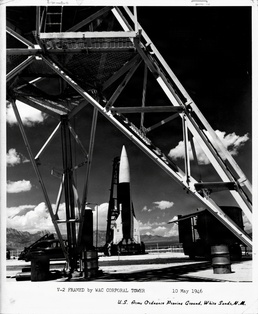
1940s: The Birth of U.S. Rocketry and Space Exploration White Sands Missile Range has a significant legacy in space exploration history, starting with “Tiny Tim” WAC Corporal dummy booster, launched 26 September 1945. Then came the pivotal launch of the V-2 rocket in 1946. This event was groundbreaking as it marked the first time a rocket was launched by the United States from White Sands, utilizing advanced technology derived from captured German V-2 rocket designs developed during World War II. The V-2 rocket, which ascended to the very edge of space, symbolized the United States' entry into space technology and laid the foundation for future developments in this field.
Following the V-2's launch, WSMR became a crucial hub for testing and developing a range of American missile systems, including the iconic Redstone and Jupiter rockets. These systems played a vital role in the early U.S. space program and in 1948 led to the testing of the Convair MX-774 also known as RTV-A-2 Hiroc (high-altitude rocket), three Hirocs were tested at WSMR. The information and testing of this technology directly attributed to the Atlas, the first American intercontinental ballistic missile.
1950s: Cold War Innovation and the First U.S. Satellite Launch The Cold War era, characterized by intense geopolitical tensions and rivalry between the United States and the Soviet Union, significantly shaped the dynamics of the 1950s. During this period, the U.S. space race emerged as a pivotal front in this confrontation, with White Sands Missile Range playing a crucial role in America's ambitions in space exploration.
In 1958, WSMR was instrumental in the successful launch of America's first satellite, Explorer 1, which was propelled into orbit atop the Juno I rocket. This landmark mission was a direct and strategic response to the Soviet Union's earlier achievement in 1957 with the launch of Sputnik, the world's first artificial satellite. The successful deployment of Explorer 1 not only marked a significant advancement in the U.S. space program but also symbolized the nation's determination to establish itself as a leader in space technology during a critical and competitive period in history.
In addition, WSMR served as the test site for the Redstone rocket, a key technological development in the U.S. space initiative. The Redstone rocket ultimately became famous for launching Alan Shepard in 1961, making him the first American astronaut to journey into space. Although Shepard's flight lasted only about 15 minutes, it was a groundbreaking achievement that underscored the United States' commitment to human space exploration and served as a crucial step in the nation's efforts to match and exceed Soviet accomplishments in space. This milestone not only boosted national morale but also set the stage for future missions and advancements in the ongoing space race.
1960s: Supporting the Apollo Program and Historic Space Milestones The 1960s emerged as a defining moment for space exploration, with the White Sands Missile Range serving as a pivotal hub in the United States' fierce space race against the Soviet Union. During this transformative decade, WSMR was instrumental in conducting critical tests for the ambitious Redstone rockets, which were foundational to the Mercury and Gemini programs. These early space missions played a significant role in advancing human spaceflight capabilities and preparing the nation for its ultimate goal: landing a man on the Moon.
The Mercury program, initiated in the late 1950s, was the first American effort to put astronauts into orbit and demonstrate the feasibility of space travel. It featured a series of historic missions that included pioneering astronauts such as John Glenn, who became the first American to orbit the Earth in February 1962, and Gus Grissom, who participated in both Mercury and Gemini missions and was a leading figure in the development of spaceflight technologies.
Following Mercury, the Gemini program expanded upon these early successes, focusing on critical objectives such as long-duration flights, spacewalking, and orbital maneuvers. This program not only tested the limits of human endurance in space but also laid the groundwork for the Apollo missions that would ultimately achieve the monumental goal of landing on the lunar surface. Through rigorous testing and invaluable data collected at WSMR, the United States made significant strides towards realizing its ambitions in space exploration.
In the early 1960s, WSMR played a key role in testing components for rockets such as the Saturn I and Saturn IB, which supported NASA's Apollo program. These rockets were essential for the lunar missions. Various tests of the systems that supported the missions were conducted at WSMR, culminating in the historic Apollo 11 mission, when astronauts Neil Armstrong and Buzz Aldrin landed on the Moon in 1969. WSMR's contributions were vital in making this historic achievement possible.
America's Range White Sands Missile Range has played a vital role in shaping the trajectory of the U.S. space program. From its early days testing the V-2 rocket to its support of groundbreaking space missions, the range's strategic location and advanced facilities have been instrumental in developing missile systems and pioneering space technologies. As we continue to explore the cosmos, the legacy of White Sands serves as a reminder of the critical contributions that have propelled U.S. space exploration forward, paving the way for future achievements. America's Range. First to Test! White Sands Missile Range has been a pivotal player in the evolution of missile systems, rocket testing, and space exploration. Since its inception in 1945, the range has facilitated a variety of groundbreaking activities, including early missile tests and critical space missions. This article delves into WSMR's significant contributions to space exploration during the transformative years of the 1940s to the 1960s—a period when advancements in aerospace technology became a national priority and laid the groundwork for future space travel.
1940s: The Birth of U.S. Rocketry and Space Exploration White Sands Missile Range has a significant legacy in space exploration history, starting with “Tiny Tim” WAC Corporal dummy booster, launched 26 September 1945. Then came the pivotal launch of the V-2 rocket in 1946. This event was groundbreaking as it marked the first time a rocket was launched by the United States from White Sands, utilizing advanced technology derived from captured German V-2 rocket designs developed during World War II. The V-2 rocket, which ascended to the very edge of space, symbolized the United States' entry into space technology and laid the foundation for future developments in this field.
Following the V-2's launch, WSMR became a crucial hub for testing and developing a range of American missile systems, including the iconic Redstone and Jupiter rockets. These systems played a vital role in the early U.S. space program and in 1948 led to the testing of the Convair MX-774 also known as RTV-A-2 Hiroc (high-altitude rocket), three Hirocs were tested at WSMR. The information and testing of this technology directly attributed to the Atlas, the first American intercontinental ballistic missile.
1950s: Cold War Innovation and the First U.S. Satellite Launch The Cold War era, characterized by intense geopolitical tensions and rivalry between the United States and the Soviet Union, significantly shaped the dynamics of the 1950s. During this period, the U.S. space race emerged as a pivotal front in this confrontation, with White Sands Missile Range playing a crucial role in America's ambitions in space exploration.
In 1958, WSMR was instrumental in the successful launch of America's first satellite, Explorer 1, which was propelled into orbit atop the Juno I rocket. This landmark mission was a direct and strategic response to the Soviet Union's earlier achievement in 1957 with the launch of Sputnik, the world's first artificial satellite. The successful deployment of Explorer 1 not only marked a significant advancement in the U.S. space program but also symbolized the nation's determination to establish itself as a leader in space technology during a critical and competitive period in history.
In addition, WSMR served as the test site for the Redstone rocket, a key technological development in the U.S. space initiative. The Redstone rocket ultimately became famous for launching Alan Shepard in 1961, making him the first American astronaut to journey into space. Although Shepard's flight lasted only about 15 minutes, it was a groundbreaking achievement that underscored the United States' commitment to human space exploration and served as a crucial step in the nation's efforts to match and exceed Soviet accomplishments in space. This milestone not only boosted national morale but also set the stage for future missions and advancements in the ongoing space race.
1960s: Supporting the Apollo Program and Historic Space Milestones The 1960s emerged as a defining moment for space exploration, with the White Sands Missile Range serving as a pivotal hub in the United States' fierce space race against the Soviet Union. During this transformative decade, WSMR was instrumental in conducting critical tests for the ambitious Redstone rockets, which were foundational to the Mercury and Gemini programs. These early space missions played a significant role in advancing human spaceflight capabilities and preparing the nation for its ultimate goal: landing a man on the Moon.
The Mercury program, initiated in the late 1950s, was the first American effort to put astronauts into orbit and demonstrate the feasibility of space travel. It featured a series of historic missions that included pioneering astronauts such as John Glenn, who became the first American to orbit the Earth in February 1962, and Gus Grissom, who participated in both Mercury and Gemini missions and was a leading figure in the development of spaceflight technologies.
Following Mercury, the Gemini program expanded upon these early successes, focusing on critical objectives such as long-duration flights, spacewalking, and orbital maneuvers. This program not only tested the limits of human endurance in space but also laid the groundwork for the Apollo missions that would ultimately achieve the monumental goal of landing on the lunar surface. Through rigorous testing and invaluable data collected at WSMR, the United States made significant strides towards realizing its ambitions in space exploration.
In the early 1960s, WSMR played a key role in testing components for rockets such as the Saturn I and Saturn IB, which supported NASA's Apollo program. These rockets were essential for the lunar missions. Various tests of the systems that supported the missions were conducted at WSMR, culminating in the historic Apollo 11 mission, when astronauts Neil Armstrong and Buzz Aldrin landed on the Moon in 1969. WSMR's contributions were vital in making this historic achievement possible.
America's Range White Sands Missile Range has played a vital role in shaping the trajectory of the U.S. space program. From its early days testing the V-2 rocket to its support of groundbreaking space missions, the range's strategic location and advanced facilities have been instrumental in developing missile systems and pioneering space technologies. As we continue to explore the cosmos, the legacy of White Sands serves as a reminder of the critical contributions that have propelled U.S. space exploration forward, paving the way for future achievements. America's Range. First to Test!