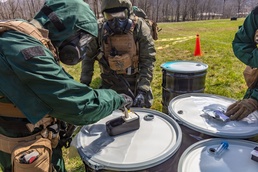
CAMP DAWSON, W.Va. – In the mountains of West Virginia, the future of military defense against chemical, biological, radiological, and nuclear (CBRN) threats took center stage as the Joint Science and Technology Office (JSTO) hosted the Science & Technology CBRN-Capability Operational User Trial 2026 (SCOUT 26), a large and informative field experiment.From March 20 to 26, more than 100 members of the Joint Forces, leading scientists, and industry experts converged to test and evaluate cutting-edge technologies in realistic, peer-threat scenarios.
This year’s exercise aimed to strengthen biodefense and deterrence, especially for the INDOPACOM region. The event had three main parts: large-scale field scenarios to test capabilities in real-world settings, a focused experiment to develop quick diagnostic tools for frontline medical support, and a showcase for new technologies where users could give immediate feedback. This three-part approach helps JSTO find new ideas, test important concepts, and provide useful recommendations to accelerate the deployment of new tools to the military. Joel Schleicher, theProgram Managerfor SCOUT 26 at JSTO, called the event a big step forward for defense innovation. “We have moved beyond a simple technology showcase,” Schleicher explained. “SCOUT is now a thorough experimentation campaign designed to scout promising technologies, assess their integration potential, and provide the data-driven insights needed to accelerate the entire capability pipeline. Our goal is to assess next-gen technologies that will make our response faster and more decisive.”
A key part of SCOUT 26 was three live scenarios in which warfighters participated in challenging field exercises using 18 advanced prototypes. These exercises simulated real threats, such as a drone dropping an unknown chemical on a supply point, radiological hazards used to block movement, and a complex CBRN attack on a mock U.S. port.
“It's a big deal to get to touch new technology at this stage,” said Staff Sergeant Christopher Kingham with the 56 CRC from Fort Campbell, Kentucky. “We can give this feedback to the techs that are working on this equipment. So, when it gets back to us, you can see that they listen.” Kingham also appreciated working with other branches, saying, “No other training exercise I've done has been like this one so far. We've been able to collaborate with the other services that are here.”
At the same time as the scenarios, a team ran a focused experiment on battlefield medicine. Fifteen specialists from the Naval Research Laboratory (NRL) and other expert groups worked to create a PCR-based diagnostic test for a new biothreat in less than 10 hours. This experiment shows whether it is possible to make custom, on-demand diagnostics in the field, which could help avoid dangerous delays in sending samples and supplies. “The ability to have diagnostic tools far forward without having to reach back to CONUS, which may not be possible, is significant,” said U.S. Army Lt. Col. Brandon Pybus, a biochemist with the Army’s 1st Global Field Medical Laboratory, as he discussed the value of having medical diagnostics available in the field. “It is a real enabler for commanders because they'll have that information to make force protection decisions. This frees up the forces for movement, maneuver, power projection, etc.”
The third part of the campaign, called the “Concepts Crucible,” gave warfighters the opportunity to provide direct feedback on 16 new and early-stage technologies. Researchers and developers presented early-stage concepts and received important user input long before major funding decisions are made. The technologies included a chip-based scent-detection system that works like a mammal’s nose to detect airborne chemical threats, and a “BioDome” concept that could create real-time medical countermeasures against CBRN threats in the field. The week ended with a Distinguished Visitor Day, during which senior leaders from the Department of War and other government agencies observed the experiments and spoke with participants. The event provided a big-picture view of the technologies and the useful data they produce, showing how SCOUT helps guide important military efforts and meets key needs.
Dr. Robert Kristovich, Director of the Joint Science and Technology Office at the Defense Threat Reduction Agency, summed up the week by highlighting the event’s strategic importance.
“SCOUT 26 embodies our mandate to deliver capability at the speed of relevance,” Dr. Kristovich stated. “What we witnessed here at Camp Dawson wasn't merely a test of technology, but a powerful demonstration of collaboration. By bringing warfighters, scientists, and industry partners together into this innovation ecosystem, we are not only de-risking future investments but are actively forging the tools that will ensure our nation’s dominance and safety against any CBRN threat, anywhere in the world. The actionable data and direct user feedback generated this week will accelerate our efforts for years to come.”