As the United States prepares to celebrate its 250th birthday, there is a natural pull to look back — to reconsider the people, places and moments that shaped the nation.
In Monroe County, Wisconsin, that reflection carries a certain irony. The county bears the name of James Monroe, the nation’s fifth president, even though he never set foot in the region. Yet the story of Monroe County is not defined by its namesake, but by the generations of people who built lives there — and by one man who has spent more than two decades making sure those lives are remembered.
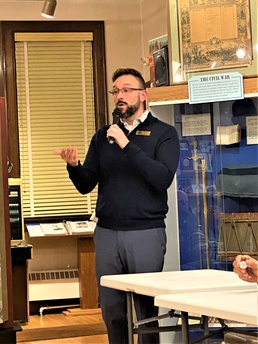
For more than 20 years, Jarrod Roll has served as director of the Monroe County Local History Room and Museum, a position that is at once highly visible and largely unseen.
Visitors know him as the person who can guide them through exhibits, answer obscure questions, or help trace a family lineage. But much of his work happens quietly — behind the scenes, in the steady, meticulous effort required to collect, preserve and interpret the story of an entire county.
Roll is quick to correct a common assumption about what he does.
“When I applied, it was for county historian,” he said. “But I’m not a county historian… I’m a manager of a museum and archives.”
It is a distinction that says as much about the evolution of the job as it does about Roll himself. The position was created in 1976, during the surge of patriotic energy surrounding the nation’s bicentennial. Across the country, communities rediscovered an interest in local and family history. In Monroe County, that interest took hold in a particularly lasting way.
A bicentennial committee formed to organize celebrations quickly realized that the enthusiasm they were seeing — people digging into genealogy, asking questions about their communities, wanting to preserve artifacts — should not be temporary. They approached county leaders with an idea: create a permanent space and a paid position dedicated to safeguarding Monroe County’s history.
The county agreed, funding both a facility and a role that would anchor that mission for decades to come.
Looking back now, as the country approaches its 250th anniversary, the symmetry is hard to miss. The same spirit that led to the creation of Roll’s position — an awareness that history matters, and that it must be actively preserved — remains just as relevant.
Roll often reflects on that origin story, not as a historical footnote, but as a responsibility.
“It was the foresight of those folks in 1976,” he said. “They saw the value in it, and the county has honored that for 50 years.”
Honoring that legacy has meant adapting the role to fit reality. The title “county historian” suggested a singular authority on the past, but Roll quickly realized that Monroe County’s history was far too broad — and too rich — for any one person to fully know.
“There are people in this county who know way more about specific topics than I do,” he said.
Instead, his job is to bring those pieces together—to create a place where knowledge can be collected, organized and shared. It is part administrator, part curator, part educator, and part collaborator. It is also, at times, an exercise in balancing priorities.
The work he enjoys most—immersing himself in research and crafting narratives—often has to wait.
“In order to write and create a presentation, I had to do it outside my normal work hours,” he said. “During the day, there’s no time to buckle down and start researching.”
That reality reveals something essential about the nature of local historical work. It is not simply about discovering stories; it is about maintaining the infrastructure that allows those stories to exist in the first place. Collections must be cataloged, preserved and made accessible. Exhibits must be designed. Visitors must be assisted. Partnerships must be maintained. And all of it must function within the constraints of time, funding and space.
The result, in Monroe County, is a facility that often surprises those who walk through its doors. Roll recalls a recent visitor researching family history who was struck not just by what was available, but by how easy it was to access.
“I cannot believe how wonderful this facility is,” the visitor told him.
That reaction is not uncommon, and it speaks to decades of work — not just by Roll, but by the volunteers and predecessors who helped build the collection.
“This isn’t something I did by myself,” he said. “We’ve been doing this for 50 years.”
If the archives are the backbone of Roll’s work, the people of Monroe County are its heart. And one of the first things he noticed when he began his job was just how deeply military service runs through the community.
“It became very clear right away,” he said. “There were a lot of veterans living here.”
That realization shaped some of his earliest efforts, including an exhibit on Korean War veterans that connected him with local service organizations and opened the door to countless personal stories. Over time, those connections expanded, reflecting the broader influence of Fort McCoy, the military installation that has long been central to the county’s identity.
The presence of Fort McCoy has created a unique dynamic. Soldiers come to Monroe County from across the country — sometimes for training, sometimes for deployment—and many of them return later in life.
“They come back and retire here,” Roll said.
It is a pattern that adds layers to the county’s history, blending local and national narratives in ways that are both subtle and profound. A visitor signing the guest book might list South Carolina or Texas as their home, but their connection to Monroe County is real — formed through experience, memory and, often, a sense of belonging.
Roll sees those connections play out every day. A group of visitors walks in on a quiet afternoon. They are not from the area, but they are curious. They explore the exhibits, ask questions, and begin to see how their own experiences interact with the place.
“It’s just great talking to them,” he said.
Those interactions reinforce a central truth of Roll’s work: history is not static. It is something people carry with them, something that evolves as new stories are added and old ones are rediscovered.
In Monroe County, those stories stretch far beyond any single theme. There is military history tied to Fort McCoy and the Veterans Administration Medical Center. There are stories of global significance, like the Japanese American soldiers who trained in the area during World War II, or the Cuban refugees who arrived in 1980, bringing an international dimension to a rural Wisconsin community.
There are also deeply personal stories — like those of families displaced during World War II to make way for military expansion. Roll recalls one volunteer who still remembers that moment vividly, even though she was only a child at the time.
“She remembers her mom crying,” he said.
Such memories underscore the human impact of historical events, reminding visitors that history is not just a series of dates and facts, but a collection of lived experiences.
Beyond those narratives, Monroe County’s identity has been shaped by geography and movement. Long before modern infrastructure, the area sat at the crossroads of early travel routes — paths that would later become state roads, then rail lines, and eventually major highways. Each layer of transportation brought new opportunities, new people, and new stories.
“Sparta was at the crossroads of two state roads,” Roll explained.
That position helped accelerate development, turning the county into a hub of activity. Even today, the legacy of those early routes can be seen in the region’s continued growth and connectivity.
Yet for all its connections to broader networks, Monroe County has retained a strong sense of local identity. It remains, in many ways, a rural place — one where agriculture has played a central role for generations, even as economic changes reshape the landscape.
There is, Roll notes, a quiet pride in that continuity.
“People will tell you they’re third or fourth generation,” he said.
That pride is not just about longevity; it is about belonging. It is about the sense that, despite change, there is something enduring about the community.
For Roll, capturing that sense is just as important as preserving artifacts or documents. History, after all, is not only what happened — it is how people understand what happened, and how they carry that understanding forward.
As the nation approaches its 250th anniversary, that work takes on added urgency. Milestones invite reflection, but they also raise questions about what will be remembered and what might be lost.
In Monroe County, those questions are answered, in part, by the steady work of one man and the institution he helps lead. Day by day, Jarrod Roll gathers the fragments of the past — stories, records, memories—and ensures they remain accessible to the present.
The county may be named for a president who never knew it, but its true history lies in the people who have lived there, served there, and passed through its crossroads. And thanks to Roll, those stories—large and small, local and global — are not slipping away.
They are being preserved, shared, and carried forward, ready to be rediscovered by the next generation as America begins its next chapter.
Learn more about Monroe County history by visiting the Monroe County Local History Room in Sparta, Wis., or go online to https://monroecountyhistory.org.