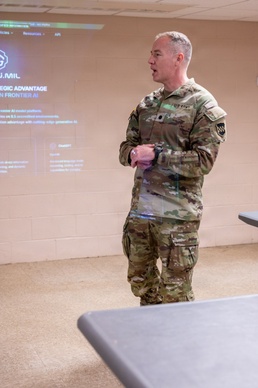
JOINT BASE MCGUIRE-DIX-LAKEHURST, N.J -- U.S. Army Reserve Lt. Col. Raymond Ragan, the commander of the 361st Theater Public Affairs Support Element (TPASE), led a class covering utilizing artificial intelligence in Army public affairs operations April 9, 2026, at Fort Dix, New Jersey.
The 361st TPASE, a U.S. Army Reserve unit under the 99th Readiness Division, and its mobile public affairs detachments provide expeditionary public affairs capabilities to support missions worldwide.
The class focused on leveraging GenAI, the Department of War’s bespoke AI platform, to rapidly produce news articles and gain a decisive edge in countering enemy narratives, what effective prompt engineering looks like, and ethics in using AI.
“We are in a cognitive fight, told through the narrative to support multidomain operations, and the enemy can lie,” Ragan said. “As the old adage says, a lie can travel halfway around the world while the truth is putting its shoes on, and that is a challenge for public affairs. We have to fact check a message before we push it out to our audience, we have to ensure there are no risks to security, and we have to make sure they follow current policy. All of which takes time. We cannot lose the narrative fight, otherwise the enemy will displace our message.”
Ragan holds two AI patents while also serving as a chief information officer for a startup company that develops frictionless customer service AI in his civilian capacity.
Covering prompt engineering, Ragan noted that to produce articles quickly and effectively, users must lead GenAI to work efficiently through a five-part prompt.
“First, you give it a persona: a Defense Information School-trained Soldier,” Ragan said. “Then you give it context: what information do you have on the subject. Next, you give it the ask: I want you to create something. After that, you give it constraints: I want you to write it according to AP style, but I don’t want you to use hyphens or semicolons. Finally, tell it to interview you to clarify before you generate your response. This part is important because it might ask you questions of things you hadn’t thought of.”
Ragan then ran various prompts through GenAI to demonstrate the process and discuss the product produced, highlighting the differences between general prompts and the five-part prompt, while also pointing to the strengths and weaknesses of the products.
For U.S. Army Reserve Staff Sgt. Tyler Matz, a public affairs mass communications specialist with the 326th MPAD, the demonstration had a positive effect on his attitude towards AI.
“Before this class, I’ve always looked at AI as something I don’t fully understand and do not want to use,” Matz said. “The demonstration really opened my eyes as to not only what it is capable of but also how to use it in a way that will be helpful to my team. I’m excited to practice with GenAI and I’m excited to incorporate the lessons I’ve learned here into training plans that create the same kind of excitement at my unit.”
While using GenAI is critical to increasing the speed at which PA products are produced, it’s imperative that leaders do not pass responsibility on to GenAI to fact check and ensure there are not any operational security violations, Ragan said.
“The Army wants us to use AI, and it is authorized to use in public affairs, but there are constraints on it,” Ragan said. “We are accountable to the AI tools that we use. Nothing leaves your newsroom that hasn’t been personally signed off by someone.”
To further emphasize the point, Ragan covered key parts of Department of Defense Instruction 5400.19, Public Affairs Use of Artificial Intelligence, highlighting guiding principles, policy limitations and transparency guidelines of generative AI use.
“We have something very cool, and that’s called being Soldiers and leaders,” Ragan said. “We want to see our Soldiers working hard on their computers and using GenAI as a tool to increase the efficiency of the work. We cannot accept Soldiers using GenAI to check the block and move on to something else.”
U.S. Army Reserve Pfc. Isabella Youngblood, a public affairs mass communication specialist with the 354th MPAD, appreciated learning the constraints of using AI in public affairs, but also understanding the possibilities of AI.
“It was very informative to know what we can and can’t use AI for in public affairs, and how to use AI,” Youngblood said. “I thought it was important to learn about the Generative AI Decision Matrix in the DODI as well, learning how and when I need to notify the public when generative AI has been used. But I plan to use GenAI in the future, and I now know that when writing an article, it can quickly give me some ideas on where to start, or it can give me a new perspective on ways to draft the article.”
Creating that inspiration and understanding the necessity of speed was the goal of the class for Ragan, who wrapped up the class emphasizing the information environment that the Army is currently in.
“Our adversaries are moving much more quickly, so we need to move much more quickly,” Ragan said. “We must use AI as a tool to get content published quickly to refute and counter an enemy narrative. But I also want AI to inspire second and third order of innovation, because no matter how bad the AI is today, it is the worse AI you will ever use. In other words, it is always going to get better.”