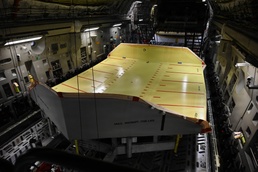
STEWART AIR NATIONAL GUARD BASE, N.Y. -- It started with a puddle on the cargo floor.
In 2018, maintainers with the 105th Airlift Wing noticed fuel leaking from a drain port on one of the unit’s C-17 Globemaster IIIs at Stewart Air National Guard Base, Newburgh, New York. At the time, neither the 105th nor any other wing in the Air Force was qualified to perform the highly specialized procedure needed to fix the problem. Since then, the 105th has gained this expertise and now trains other C-17 units across the country.
The maintainers had traced that original leak to the extended-range fuel tank in the aircraft’s center wing. This tank provides extra fuel capacity, significantly extending C-17s’ flying range for global missions.
Fixing the problem meant they had to drop the secondary barrier, a 550-pound composite structure that covers the tank. Serving as a safety catch, it traps any fuel leaks from the tank to prevent drips into the cargo bay where they could contact personnel or equipment.
“Nobody was trained on it,” said Master Sgt. Shawn Dutcher, a fuel systems craftsman with the 105th Maintenance Squadron. “We reached out to different bases, active duty and guard, but nobody had done it.”
The 105th brought in a Boeing team in 2018 to teach them the procedure. After learning the process, they began performing the work themselves.
Dropping the secondary barrier requires precision and specialized equipment.
A minimum six-person crew must carefully remove the barrier, supported by a 1,500-pound cradle, then inspect and repair the leak. Afterward, they raise the barrier back into place, reseal it and pressurize the system to ensure it is leak-free.
Safety measures for this process are strict. More than 2,000 pounds hang suspended above the maintainers, leaving little room for error.
Because of the fuel leak, the plane’s power must stay off to avoid any risk of explosion, so special safe lights are used to brighten the cargo area. This prevents any sparks near the fuel vapors while allowing maintainers to see what they’re doing.
After learning the process, 105th maintainers began performing the work themselves and teaching Airmen from other units.
“Because the job is so specialized, we began inviting maintenance teams from across the country to Stewart for hands-on training,” said Master Sgt. James Petrone, a fuel systems craftsman with the squadron.
The 105th Maintenance Squadron has now done the procedure multiple times and regularly hosts teams from other bases to share what they have learned. Invitations are sent directly to C-17 maintenance squadrons’ fuel cell shop chiefs nationwide.
Teams from the 172nd Airlift Wing in Mississippi, 145th Airlift Wing in North Carolina and 535th Airlift Squadron in Hawaii have already visited.
Maintenance teams from other bases learn the full barrier-drop process and become qualified to perform it independently. They also observe broader shop practices developed over years on the C-17 aircraft, which the 105th has operated since receiving its first one in 2011.
Continuity is common in the Air National Guard as many Airmen work on the same aircraft for years or even decades. This wealth of experience has allowed the 105th to refine its techniques and pass them on to visiting teams.
The exchanges benefit everyone, according to Dutcher. Visiting teams return home equipped to handle extended-range fuel tank issues without external help, strengthening fleet-wide readiness. For the 105th, the visits provide extra hands to increase efficiency and help build a support network among C-17 fuel cell shops.