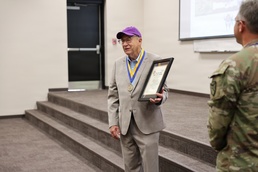
FORT RUCKER, Ala.--A class of new flight school students heard from a Vietnam veteran aviator and recipient of the second-highest medal awarded for combat valor, just prior to donning their purple hats for the first time during a Class Color Ceremony at Fort Rucker, Ala., April 13, 2026.
The wearing of colored hats is an Army flight school tradition dating back to the 1960s, where each new class is assigned a specific color hat. The custom intends to foster a culture of increased cohesion, technical and tactical rigor and personal accountability.
Fellow “purple hatter” and decorated former scout aviator, retired Lt. Col. Wesley F. Walker earned his aviator’s wings at Fort Rucker in 1971. As an Army aviator, he received the Distinguished Service Cross for his service in Vietnam, as well as earning three Distinguished Flying Crosses, the Air Medal for Valor, numerous Air Medals and the Bronze Star (with Palm).
Walker said he was “just doing his job” and was a “small part of a terrific team of Army aviators” on July 11, 1972, noting that many other days during his tour in Vietnam were “equally as perilous.”
That day, Walker displayed extraordinary heroism in connection with military operations involving conflict with an armed hostile force while serving as pilot of a light observation helicopter in Troop F, 4th Air Cavalry Regiment, 1st Aviation Brigade, on a voluntary rescue mission behind enemy lines north of Quang Tri City, Republic of Vietnam.
A first lieutenant at the time, he served as the wingman of a scout team on an emergency rescue mission. Walker and his team leader were engaged by extremely intense small arms, automatic weapons, anti-aircraft fires and heat sinking missiles. Despite the intense hostile fire, he continued to return fire for fire accurately to cover his team leader and assist in the search for the downed American crew.
He flew to the downed crew’s position, laying down accurate suppressive fire, landed and picked up survivors. His aircraft was greatly overloaded with the additional weight, but he skillfully flew and departed the area. He was responsible for the rescue of five American air crewmen and one Vietnamese Marine, who were severely burned or wounded, preventing certain capture or death at the enemy’s hands.
Walker credited the “hand of God” for shielding him as a scout pilot in Vietnam. “There is no other way to explain how I survived that year,” he said.
In the late 1970s, Walker went on to join the South Carolina National Guard and served until retirement in 1994.
Walker said the opportunity to share some of his experiences with flight school students at Fort Rucker was “really inspirational.”
Clad in his own purple hat, he said, “It just excites me that it’s the purple hats, and they’re going to be going through a lot of the same experiences I went through here at Fort Rucker. It’s just a real privilege and honor to be invited to do this,” he said.
“I just love youth,” he said. “We’ve got some good kids coming up, and they’re better than my generation. And I think they’ll leave a better America than during my time.”
Walker's presentation slides showed photos from his time in service, for a then-and-now comparison of housing and aircraft, combat operations, injecting humor as well as seriousness.
He said in flight school they are learning to manage risk, and he emphasized emergency procedures and the importance of Army Regulation 95-1. “That’s your Bible,” he said.
The former OH-6 helicopter pilot said when he first learned about the scout mission, he thought it sounded crazy. “You don’t go down in the trees and find the bad guys and, if you have to, stir them up so they will shoot so you know where they are,” he said. “But that’s pretty much what we did.”
He spoke about the strong bonds formed with fellow servicemembers especially during combat, and asked the students on the spot to introduce themselves to the people seated near them in class.
“Y’all are all in this together. If the one on the left or right fails, it’s your fault too. You share the responsibility. You’re your brother’s keepers in this,” he said. “This is a bond that will last forever.”
He said they should be proud to wear the uniform and be an aviator, adding that though they will embrace new technologies, they still must fly the aircraft.
“You’ve got some of the best training in the world, some of the best trainers in the world, and the best aircraft in the world. You’re on your way to being a member of the elite Army aviation community,” he said.
Following Walker’s remarks, the class was called to attention. To the flight school class, Walker called out, “Don your purple hats!” He then led the students in a hearty chant of, “Hooah, Hooah, Hooah!”
Col. Michael H. Gourgues, 1st Aviation Brigade commander, presented Walker with a commander’s coin. He said that Walker making the time and effort to come speak to the class “means more than you know” to flight school students.
“They can hear about the Warrior Ethos all day, but it doesn’t become real until you meet it personified,” said Gourgues.
During the ceremony, the Honorable Order of St. Michael Bronze Award was presented to Walker for his outstanding contributions to the Army aviation community. Col. Keith Hill, 110th Aviation Brigade commander, who also presented a coin to Walker, noted that it was the first time an Order of St. Michael had been awarded during a Class Color Ceremony.
He urged flight school students to be mindful that they are in the company of legendary aviators at Fort Rucker.
“There is so much history around you. While you’re here you’re probably not even going to learn a tenth of it,” Hill said. “You’ll be Big Mike’s (restaurant) or in-processing in the Mike Novosel Center, and you’ll never know what kind of legends are within feet of you.”
“We’re going to give you a good education on how to become Army aviators,” Hill said, “but what’s really incredible is the education you can get in the margins while you’re here, the stuff we’re not going to put in the books, not going to test you on, but some of these stories will become some of the most important lessons that you learn.”