FORT EUSTIS, Va.– Department of the Army civilians are leveraging their operational expertise to broaden learning and sharpen skills across the 597th Transportation Brigade, Army Transportation Command (ARTRANS), underscoring the critical role civilians play in Army readiness.
In April, two members of the brigade’s operations team led focused training sessions on port operations, giving Soldiers and civilians a deeper understanding of how their work fits into the larger deployment and distribution mission.
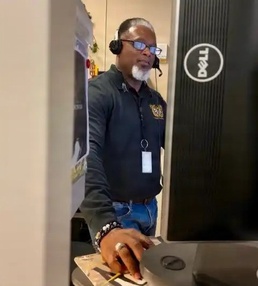
On April 9, 2026, Army veteran Darin Newman, Rapid Support operations team, transportation planning specialist, taught a class on Joint Task Force-Port Opening (JTF-PO)– an important concept developed by ARTRANS and the United States Transportation Command (USTRANSCOM), that brings logistical support to our warfighters in austere areas where a military footprint is not yet established or where civilian infrastructure is damaged or degraded and can’t support humanitarian aid missions.
JTF-PO integrates Army, Navy and Air Force efforts to the reception and onward movement of Troops, supplies, and humanitarian aid is seamless and immediate, fulfilling our commitment to deliver “at the speed of need” anywhere across the globe.
The training session, which was streamed to our battalions in Texas and South Carolina, walked participants through real-world planning considerations, coordination requirements and best practices for working within a joint environment at strategic seaports.
Earlier in the month, Army veteran Joe Hayslett, operations team transportation specialist, used Leader’s Time Training (LTT) to teach a class on port-to-port operations, focusing on analyzing the sea-journey stage of our logistics operations and understanding seaport strategic deployment within the transportation network.
The training included a breakdown of the organizations and roles within seaport operations, to include types of vessels, cargo-handling, seaport of embarkation (SPOE) functional areas, and unit responsibilities during SPOE operations.
Port-to-port operations are critical for the Army and Joint Force because they enable the rapid deployment, reception, and sustainment of forces and heavy equipment globally.
These operations secure the “first mile” of power projection, moving assets from installations to strategic seaports to sustain theater opening and combat readiness.
Hayslett shed light on complex movements, explaining task delegation and roles in a way that translates into smoother execution at the port.
These in-depth training sessions highlight how Army civilians bring continuity and depth of experience to the formation.
U.S. Army Capt. Whitney Hodge, Rapid Support plans and training officer, says having DA civilians in the formation is critical.
“One of the real advantages of having DA Civilians in the formation is the depth of insight they carry from years of working these processes,” Hodge said. “They help bridge the gap between doctrine and what actually happens on the ground, and they see the mission from a different angle that complements our Soldiers’ perspective.”
Hodge added that Hayslett’s port operations LTT was a clear example.
“His instruction was practical, grounded in real experience, and strengthened the team’s understanding of how port operations truly unfold,” Hodge said.
Training like this supports the brigade’s focus on building agile, knowledgeable teams capable of operating in complex environments.
The 597th Transportation Brigade “Rapid Support” provides power projection capability through strategic seaports to deliver and sustain the Joint Force; DA civilian-led training efforts directly reinforce that mission and advance the brigade’s vision of a team of Army civilian professionals, Soldiers and Sailors, partnered with commercial industry to support global operations and move the Joint Force across the competition–conflict continuum, from day-to-day competition to large-scale combat operations.
As the 597th Transportation Brigade continues to support global deployment and distribution operations, its DA civilians remain a vital source of expertise—broadening knowledge, preserving institutional memory and helping prepare the force for the next mission.