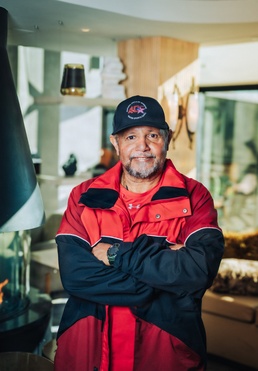
At the top of Snowmass this year, Jorge DeCastro-Cordeiro paused and looked out over the mountain. He took a deep breath and closed his eyes for a minute. He steadied himself, settled into the moment, and gave silent homage to his son.
“Snowmass is a mountain of healing,” he said, describing the moment. “You can feel it up here.”
A retired Army Ranger, who served 22 years with multiple deployments, DeCastro-Cordeiro, who receives his care from the West Palm Beach VA, had been coming to the National Disabled Veterans Winter Sports Clinic since 2018. For years, he asserted that the mountain had become more than a physical challenge. It had become a place to mend your soul.
That belief carried him through an unimaginable tragedy that occurred before last year’s event.
Just three weeks before the clinic, his 27-year-old son, Jorge, died from heart complications. The grief was overwhelming and he was given the option to cancel his trip. He only hesitated for a moment.
“I needed to be here,” he said. “I knew if I was on the mountain, I could receive the healing.”
That same week, volunteer ski instructor Heidi Lamb arrived. A long-time instructor from Ohio, she had participated in nine clinics since 2014. A few days after arriving, she learned her brother, a ski instructor at a resort in Montana, had passed away while skiing.
“I was in a very dark place,” she said.
Both said being paired as a team was a sign from a higher power, as each was raw from grief. DeCastro-Cordeiro shared with Lamb the lessons the mountain had given him: healing and grief can exist together and it is okay to feel broken and keep moving forward. She made the decision to stay on the mountain for the rest of the event.
“They were meant to be together as student and instructor,” added DeCastro-Cordeiro’s wife, Brinda.
For DeCastro-Cordeiro, loss was not new. Over the past six years, he has lost eight fellow service members, friends he trained and served with, to suicide. Each loss added to the weight he carried but also deepened his understanding of healing. He shared that experience with Lamb.
“I can’t explain what his words meant to me,” she said. “He is just so full of light.”
DeCastro-Cordeiro's path to sharing that light was not void of its pitfalls. In 2010, during a combat tour in Iraq, his vehicle was struck by an IED, leaving him with a traumatic brain injury that brought lasting migraines, memory challenges, and balance issues. He pushed through six more years of service before retiring in 2016 and beginning his rehabilitation. His first clinic in Snowmass, Co., helped him realize how much he needed not only the excitement of adaptive sports, but the ability to talk about healing and share his experience with other Veterans.
That need was even more poignant this year when Lamb and DeCastro-Cordeiro returned to Snowmass.
They saw each other and embraced – long and tight, holding on to a shared understanding that didn’t need words.
“It was very emotional for both of us to be back,” Lamb said. “There aren’t words to describe what it felt like.”
Through tears, she explained why she continues to come back to the clinic each year.
“It feeds my soul,” she said. “I love being around the Veterans. They’ve been through so much. If I can give something back to them when they have given everything, I know I am doing something for the greater good.”
Grief doesn’t disappear, even on the mountain. But for those who are willing to share it, it transforms into something a bit lighter – a strength that is only found through the universal experience of overcoming.
And for DeCastro-Cordeiro, that vulnerability is where healing begins.
Story by Donna J. Bell, Director of Communications, Integrated Veterans Affairs