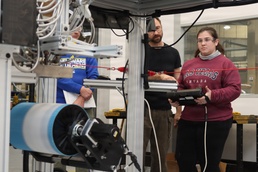
Aberdeen Proving Ground, MD – U.S. Army Combat Capabilities Development Command Chemical Biological Center (DEVCOM CBC) recently acquired a new melt spinning capability, the result of a multi-year collaboration with the Defense Threat Reduction Agency Joint Science and Technology Office and the North Carolina (NC) State University Nonwovens Institute (NWI).
Melt spinning is a process for creating non-knit, non-woven fibers, such as filters for N95 masks. At the Center, the melt spinner will be used by researchers and engineers to gain a better understanding of the materials used in the process, including their properties and potential for integration in other capabilities.
The melt spinner acquired by the Center is similar to another system at NWI, allowing formulation development and software improvements to be made in parallel between the university and Center. This second-generation machine housed in the Center’s Prototype Integration Facility features updated software and increased levels of control, allowing users to change the parameters of the flow during spinning.
Zoe Madrid, a polymer engineer at DEVCOM CBC, participated in a recent hands-on instructional module on the melt spinner, facilitated by Bruce Anderson, a trainer at the NC State University NWI.
“Bruce [Anderson] knows the machine inside and out. Getting that insight and knowledge first-hand and being able to ask direct questions gave us a huge headstart in operating the melt spinner to its fullest capacity,” noted Madrid. “We were able to troubleshoot, operate the robot with full confidence, and have a thorough side-by-side leaning style to lean on if we ever needed help. I think this is going to go a long way with our partnership at NC State University NWI.”
During melt spinning, an arm moves into place and fibers are deposited onto a spinning drum, creating a broad swathe of non-woven material in a few minutes. The fiber size can be changed by modifying the rate of air flow, allowing for the creation of extremely customizable fibers. Traditional N95 masks are made by sandwiching multiple layers of material within a single mask, creating a potential failure point if the layers were to separate. With melt spinning, these multiple different layers can be interwoven during the fabrication of single sample, eliminating the possibility of separation.
The Center currently has two other techniques for creating fibers from polymers: solution spinning and electrospinning, but melt spinning has clear advantages. The melt spinner unlocks the ability to use polymers that are incompatible with solution spinning and it is more scalable than electrospinning. A process that would take days to produce via electrospinning is reduced to minutes using the melt spinning approach.
DEVCOM CBC chief scientist and research chemical engineer, Dr. Greg Peterson, initially saw the prototype melt spinner during a meeting with NWI and knew the capability could be an asset at the Center—one with many potential use cases.
“This capability has the potential to be applied across a range of CB protection efforts,” said Peterson. “Ultimately, one of the goals of this is to make useful form factors for materials.”
Peterson noted that use cases could include filtration, aerosol collection, and integration with other capabilities developed at the Center, such as metal organic frameworks.
Center researchers plan to leverage AI/ML-based models and conduct scans using electron microscopy to take a closer look at the alignment of fibers and quantify fiber parameters. Specialized equipment for characterizing polymer and post-spinning properties will also be installed at the Center, enabling scientists to explore the possibilities for development and integration.