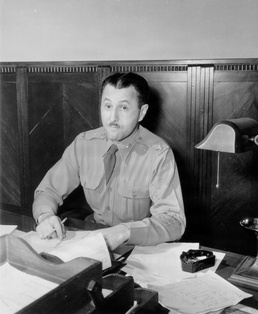
On Apr. 15, 1942, Gen. Douglas MacArthur established the Central Bureau as the theater signal intelligence (SIGINT) agency for his Southwest Pacific Area (SWPA). Built around a small core of American interceptors who escaped from Corregidor, the multi-national bureau provided valuable intelligence for MacArthur’s operations from 1942–1945.
Before MacArthur and his family and staff escaped from Corregidor on Mar. 11, he had already recognized his need for an effective theater SIGINT effort in Australia. Two of the staff members who left the Philippines with him were Col. (later Maj. Gen.) Spencer B. Akin, chief signal officer, and Lt. Col. (later Col.) Joe R. Sherr, commander of Detachment 6, 2nd Signal Service Company. Detachment 6 had been operating an intercept station in Manila since the late 1930s. Sherr, who had been in command of the small station since July 1940, had withdrawn his eighteen-man detachment in early January to Corregidor, where they continued their intercept operations even as their commander flew to Melbourne with MacArthur.
Once MacArthur reached Melbourne, he issued orders for Sherr’s operations officer, 2nd Lt. (later Lt. Col.) Howard W. Brown, and ten of his enlisted men to be evacuated on the first available transport out of the Philippines to Australia. They were to form the initial nucleus of the new Central Bureau. MacArthur then cabled the War Department of his intent to establish an allied SIGINT organization and requested additional personnel.
On Apr. 14, Lieutenant Brown secured a seat on a B-17 for the hazardous trip to Australia. Four of his men—T. Sgt. Eustace Messer, Sgt. Carl Card, Sgt. John Phelan, and Cpl. Richard Nurss—boarded another flight that night. All arrived in Australia on Apr. 15. The rest of the team remained behind, trying unsuccessfully to secure passage out of the Philippines before they were overrun by Japanese troops. Some were taken prisoner; some joined the guerrilla forces; and others attempted various means of escape.
Meanwhile, the Signal Intelligence Service (SIS) in the United States dispatched another nine officers and twenty enlisted men of the 837th Signal Service Detachment, to augment Sherr’s group in Australia. These men were placed under the command of Maj. Abraham Sinkov, one of three assistant directors of the bureau. The bureau’s other two assistant directors, Maj. Alastair W. Sandford of the Australian Army and Wing Cmdr. H. Roy Booth of the Royal Australian Air Force, initially managed seventy veterans from the Australian Special Wireless Group who had gained experience in North Africa and a handful of British intercept operators who had escaped from Singapore in February.
Colonel Akin directed this multi-national organization. Colonel Sherr acted as Akin’s executive officer and the bureau’s day-to-day technical director. He, Sanford, and Booth, all experienced codebreakers, oversaw the bureau’s fourfold mission. First, it was responsible for meeting MacArthur’s needs for intelligence through intercepting and decrypting Japanese radio traffic. It was also responsible for the signal security of Allied forces in SWPA. Next, the bureau exchanged technical data about the Japanese cryptographic system with the SIS at Arlington Hall in Washington. Lastly, it supplied adjacent theaters of operations with pertinent radio intelligence.
The Central Bureau’s initial contributions came from traffic analysis. Through the scrutiny of radio call signs and message addresses, traffic analysts reconstructed Japanese radio networks to establish lines of command and develop an enemy order of battle. While the Australians primarily concentrated on developing Japanese networks, the Americans assumed much of the codebreaking workload. In the first year, they solved the Japanese Army’s air-to-ground radio code and a similar code for the Japanese Navy. The Central Bureau built on these early successes throughout the war, providing invaluable intelligence to MacArthur as he island-hopped through the Southwest Pacific and later returned to the Philippines.
Article by Lori S. Stewart, USAICoE Command Historian. New issues of This Week in MI History are published each week. To report story errors, ask questions, request previous articles, or be added to our distribution list, please contact: TR-ICoE-Command-Historian@army.mil.