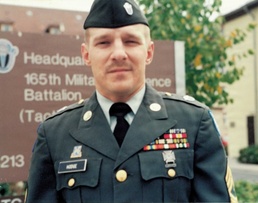
On Apr. 14, 1994, two U.S. Army UH-60 Black Hawk helicopters were shot down over Iraq during Operation Provide Comfort. Among the twenty-six casualties was Arabic linguist and interrogator Sfc. Benjamin T. Hodge.
Born in Michigan in 1961, Hodge enlisted in the U.S. Army after high school and was stationed with the Berlin Brigade in Germany in 1979. Upon his return to the U.S. in 1981, he attended interrogator training at Fort Huachuca, Arizona, and the Arabic basic language course at the Defense Language Institute in Monterey, California. He was then assigned to the 519th MI Battalion at Fort Bragg, North Carolina, as an interrogator.
In 1983, Hodge deployed to Grenada during Operation Urgent Fury to assist with the establishment of the joint enemy prisoner of war facility. He further helped collect and analyze intelligence on the size, location, and resources of the Cuban force and was recognized for his work identifying ten individuals involved in the assassination of Grenadian Prime Minister Maurice Bishop, whose execution had sparked the conflict. Hodge deployed to Central America again in 1989 as an interrogator in support of Operation Just Cause in Panama and helped establish an automated database for identifying prisoners and documents for the Joint Interrogation Facility.
In his third deployment, for Operation Desert Shield in 1990, Sergeant Hodge served as the 519th MI Battalion S-2. He put his Arabic language skills to the test as a liaison officer, coordinating with local authorities and civilians and assisting counterintelligence agents in the area. He also provided the battalion training in the basic Arabic language, culture, and Iraqi uniform and equipment identification. Once Operation Desert Storm began, Hodge served as the noncommissioned officer in charge and senior interrogator at the XVIII Airborne Corps Confinement Facility, where his team was credited with interrogating more than 8,000 prisoners. During one interrogation, Hodge collected intelligence about the locations of several minefields near the As Salman Airfield in southern Iraq, potentially saving numerous lives from the 6th Light Armor Division (French). At the conclusion of the Gulf War, Hodge returned to Fort Bragg as an instructor for the U.S. Army Forces Command Intelligence Training Detachment, before serving as interrogation platoon sergeant for the 165th MI Battalion in Darmstadt, Germany.
Meanwhile, international attention had turned to the treatment of the Kurds fleeing persecution in northern Iraq. Beginning in April 1991, the U.S., supported by a multi-national coalition, launched Operation Provide Comfort to provide humanitarian aid to the Kurds through the construction and oversight of refugee camps along the Iraq-Turkey border. Operation Provide Comfort II launched a few months later to facilitate the refugees’ return home. This operation continued over the next few years under the direction of the Combined Task Force (CTF) Provide Comfort. A tactical area of responsibility (TAOR) was established in northern Iraq above the 36th parallel to protect returning refugees, and the airspace above was designated a “no-fly zone” for Iraqi aircraft.
In March 1994, Hodge volunteered to serve as an Arabic linguist for the CTF. On the morning of Apr. 14, 1994, 32-year-old Hodge, newly arrived in the TAOR, boarded one of two helicopters departing the Military Coordination Center (MCC) in Zakho, Iraq, for Erbil as part of a routine Eagle Flight providing supplies and personnel transportation to and from the MCC. Shortly after entering the airspace, the helicopters were shot down by two U.S. Air Force F-15s patrolling the TAOR who misidentified them as Iraqi aircraft. In addition to Hodge, fourteen U.S. military personnel—including the MCC’s outgoing and incoming commanders—two British, one French, and three Turkish military officers, five Kurdish representatives, and a U.S. State Department advisor were killed.
Hodge had established himself as a well-respected linguist and interrogator during his fifteen years of active service. In 1997, his exceptional contributions to the field of military intelligence were recognized with his induction into the MI Hall of Fame.
Article by Erin E. Thompson, USAICoE Staff Historian. New issues of This Week in MI History are published each week. To report story errors, ask questions, request previous articles, or be added to our distribution list, please contact: TR-ICoE-Command-Historian@army.mil.