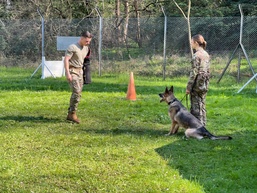
VICENZA, Italy — The stakes were high at Caserma Ederle recently as military working dog MWD teams from Germany and Italy gathered for their annual certification. For these elite K9 teams, the week-long evaluation is the only way to prove they have the capability to go out and be operationally effective.
Duane Stinson, the U.S. Army Europe-Africa MWD Program Manager, oversees approximately 180 teams. He notes that while the Army follows standards similar to civilian police departments, the military’s certification lanes are uniquely intense. The process includes explosive and drug detection, basic obedience, gunfire tasks, and "bite work" through patrol requirements like building searches and scouting.
"It’s important to show relevancy," Stinson said during the trials. "A dog is the best capability in our inventory for detection purposes. Period."
The certification process is as much about the handler's leadership as it is the dog's nose. For Specialist Abigail Bentle and her German Shepherd, Domi, the week is the culmination of months of preparation. Bentle, an explosive detector dog handler with the 525th Military Working Dog Detachment, believes the secret to success lies in the hours spent outside the training lanes.
"The first thing is building rapport," Bentle explained. "If you have a good bond, everything is just going to come easy. I look at my dog and I just know how she’s feeling and how she’s going to react as we work together as a team."
Staff Sergeant Peyton May, a drug detector dog handler, emphasized the vital role these teams play in force protection. Beyond the physical task of finding narcotics like marijuana or heroin, the dogs serve as a "psychological deterrent" to threats.
"People see the dogs and they’re like, 'Okay, I don't need to bring [illegal substances] on post,'" May said. Whether they are supporting VIP sweeps or conducting health and welfare checks in the barracks, the mission remains the same: community safety.
While the pressure is high—explosive detection dogs must maintain a 95% hit rate. For the few teams that struggle, Stinson’s office assists leaders in building training plans to fix behavioral issues or deficiencies.
"Getting out to work with the dog teams is the best part of my job," Stinson concluded. "It’s what keeps me motivated."