CAMP HUMPHREYS, South Korea – In partnership with the Public Procurement Service (PPS) and the 411th Contracting Support Battalion (411th CSB), the U.S. Army Corps of Engineers – Far East District (USACE FED) hosted its annual Industry Day and Quality Symposium April 7–8, 2026, in Suwon, South Korea.
In past years, both events were held separately. This year, the first day focused on contracting and construction, while the second day emphasized engineering and quality.
Following last year’s success, FED continued the event to continue fostering an open forum and cultivating robust relationships between all parties. It is a direct avenue for interactions with A-E representatives, prospective contractors and stakeholders.
“The reason why we combined them is because it's an opportunity for our Architect and Engineer (A-E) firms and Multiple Award Task Order Contract (MATOC) pool to engage with the contractors and the engineering department to collaborate on how to ensure that we have proper oversight in these contracts,” said, Lt. Col. Jason A. Supnet, Military Deputy to the Chief of Contracting, USACE FED.
Supnet said this format allows district staff and stakeholders to discuss improvements, understand each other’s capacity and capabilities, trends and industry patterns, innovation and share expertise to continuously achieve the district’s mission.
“But, just as importantly, it’s a chance for us to hear from you, our industry partners, who bring the expertise, innovation and capacity that make this mission possible,” said Col. Jeremiah J. Willis, commander, USACE FED. “This symposium is an opportunity to have honest discussions about what’s working, what’s not and where we can raise the bar.”
Industry Day aimed to enhance understanding of contracting processes, expand each agency’s contractor and vendor pool, and strengthen relationships with acquisition partners in South Korea. The opening session included briefings from the PPS, the 411th CSB, and the district’s Contracting Division. Jisun Kang, Chief of Contracting, USACE FED, spearheaded the district’s presentation, outlining FED’s contracting history, projected workload, regulatory framework, the Job Order Contract Program and key requirements for prospective contractors.
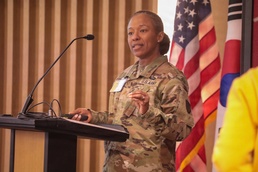
Then 411th CSB shared their capabilities, Status of Forces Agreement (SOFA) requirements; and briefed on specific areas of need such as drones, unmanned systems, cellphones and other technology needs facilitated by Lt. Col. Jet Thompson, Executive Officer; Maj. Clafdia Louis, Acquisition Officer; and Maj. Jason Yu, Military Deputy Director, Theater Contracting Center – Korea.
“The question is not if you can get the contract but more if you can sustain and execute the contract to adhere to U.S. standards in South Korea,” Louis said while discussing contracting is about discipline, influencing outcomes and understanding the reality of timelines.
The second portion began with a briefing from the Directorate of Public Works - Camp Humphreys, followed by a presentation from the district’s Construction Division, led by Jamie Hagio, Chief of Construction. His briefing encouraged discussion on defining quality, achieving U.S. construction standards in South Korea, and maintaining detailed documentation. Hagio emphasized his intent to improve processes and identify innovative ways to tackle challenges across missions, agencies and stakeholders.
“How do we measure, how do we assess, how do we measure quality,” Hagio said.
Following each speaker was a question-and-answer session for audience members to express feedback or open the floor to clarification.
The second day continued with the Quality Symposium, which focused on the Engineering Division and discussions on ways to enhance the quality and effectiveness of the district’s projects. Areas of focus included common design errors (such as ensuring adequate spacing for equipment installation, operation and maintenance) along with engineering regulations, including planning and design standards, criteria for buildings and infrastructure, and consistency in military construction. Additional topics included cybersecurity requirements, cost considerations for contractors working with FED, engineering updates and seismic design parameter changes.
A prominent part of the second day was the roundtable discussions facilitated by FED contracting and engineering personnel. Topics included improving efficiency on future projects, reducing the number of requests for information during the pre-award stage, addressing unforeseen conditions during the design phase to minimize schedule impacts, challenges in the design review and submittal process, lessons learned from completed task orders, and emerging technologies or design methodologies that could support future projects.
Overall, the event provided an open dialogue about industry standards, addressed challenges and found creative ways to be more effective in project feedback.
“Our goal is simple: better designs, fewer revisions and stronger project delivery across the board,” Willis said.
The roundtable discussions also encouraged face-to-face interaction with all stakeholders involved in these projects. As Thompson said whether big or small, there is always an opportunity for contractors to work with DoD and fulfill all stakeholders’ missions.
“Our mission is to build for peace; and we take that to heart,” said Sarah Woo, Chief of Engineer, USACE FED. “We won’t stop until we find a solution.”
Visit https://www.pof.usace.army.mil/ for more information on USACE – FED.