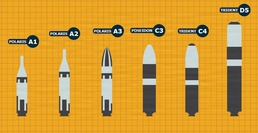
When Portfolio Acquisition Executive Strategic Systems Programs (SSP) was established in 1955 at the request of President Dwight D. Eisenhower, an unprecedented challenge was assigned to the Navy command: to work with the U.S. Army to host the Jupiter missile on a Navy vessel.
After a year of work on solid propellent technology, SSP – known as the Special Projects Office at the time – convinced the Navy to use a solid propellent missile instead of the liquid propellent Jupiter missile the Army was developing. Adm. William “Red” Raborn, the first-ever director of SSP, favored the solid propellent missile on a nuclear-powered submarine and recommended modifying an existing submarine design to hold the new missile the Navy was developing. As a result, one of the Navy’s existing SSNs, USS Scorpion, was enlarged by almost half its original size and renamed USS George Washington (SSBN 598), paying homage to the nation’s founding father.
“The Ethan Allen submarine class was the first class that was designed to be a missile shooting submarine,” William “Bill” Carritte said, a former federal employee and current supporting contractor for SSP. “The first class was just a variant of a fast-attack submarine that they cut in half to fit a new section for the Polaris missiles.”
Once the remodeling and conversion of the SSN to a SSBN was complete, it set the standard for the design of future SSBNs. The first submarines to serve the strategic deterrence mission were known as “41 for Freedom,” and were named after prominent figures in U.S. history, including 11 presidents.
The first successful launch of an underwater ballistic missile occurred in 1960 off the coast of Cape Canaveral, Florida, only five years after standing up the program. After the Polaris A1 missile was developed, tested, and equipped onto the early SSBNs, the United States made an emphatic statement around the world: The U.S. is a maritime powerhouse with a credible underwater nuclear deterrent.
“This was new technology at the time – we had a new capability that was pretty spectacular,” Carritte said. “In five years, we had gone from not being able to produce a solid propellent missile to actually launching one [a missile] off a submerged submarine – something never done before.”
Although the A1 was a significant achievement for the U.S. Navy, tests to improve the weapon system were already underway.
After the conclusion of World War II, the U.S. and the Soviet Union had deep ideological differences, leading to rising tensions and, eventually, the start of the Cold War. This set a domino effect around the world, sparking key global challenges and competitions between the two nations, including the Space Race and the nuclear arms race. During this era, the U.S. Navy accelerated its requirement for strategic deterrence capabilities and conducted strategic patrols in oceans around the world with its new weapon capability.
SSP’s no-fail mission – back then and in modern times – depends on a committed workforce of military and civilian personnel dedicated to pushing forward innovation and enhancing warfighting capabilities. While the Cold War era was being defined by a heightened global security environment, the Navy was steadfast in producing new versions of the Polaris missile, evolving its distance, navigation, and payload under each iteration.
On May 6, 1962, the U.S. conducted Operation Frigate Bird, which was part of a larger nuclear test series known as Operation Dominic in the Pacific Ocean. The tests occurred in response to the Soviet Union’s own testing of their nuclear weapons. Today, Operation Frigate Bird is the only U.S. test to have featured an operational ballistic missile with a live nuclear warhead, fired from USS Ethan Allen (SSBN 608) in the Pacific Ocean. The test demonstrated the Polaris missile’s deterrent ability. As a result of Operation Dominic, the Limited Test Ban was signed shortly after, which the U.S. continues to abide by.
As non-nuclear flight tests continued through the Poseidon and current Trident missiles, the U.S. has successfully sustained a proven strategic weapon capability that demonstrated – and continues to demonstrate – sea power and maritime dominance. However, these major milestones did not come without challenges.
“The Polaris program was very well supported and funded,” Carritte said. “When C3 – the Poseidon – came along, things had changed around the country. There wasn’t as big of a concern of not being able to launch missiles or compete with the Soviet Union. Instead, other priorities came into the national scope like the Vietnam War and the U.S. Space program. Those were all competing interests.”
By the early 1970s, most of the 41 for Freedom SSBNs were arriving to U.S. shipyards and undergoing an overhaul, shifting from Polaris to the new Poseidon C3 missiles.
“When I started in 1977, the A1 and A2 missiles were retired,” Carritte said. “31 of the 41 for Freedom submarines carrying Polaris missiles were converted to C3 missiles, the other 10 submarines carried A3 missiles. The early SSBNs needed overhauls about every 4-5 years, but those timelines have stretched and lengthened over time, up to the Ohio-class submarines that are currently deployed.”
Carritte, who devoted more than 40 years of federal service in support of the strategic deterrence mission, was aware of the missiles’ significance and recalled how the tense global security environment he grew up in shaped his daily life on the homeland.
“I remember in school there were some duck and cover drills,” he said. “We’d go underneath our desks and cover our heads with our hands. Then there was the Cuban missile crisis and the naval blockade – there were some pretty tense moments. I think having the Polaris capabilities influenced some decisions and actions – there were a lot of moments you didn’t know what was going to happen.”
Today, SSP serves as the Navy’s experts sustaining and maintaining the current Trident II D5LE Strategic Weapon System equipped on the current Ohio-class submarines. In the future, SSP will support the transition of the Trident II D5LE SWS onto the new Columbia-class submarines. The command is also modernizing the SWS and pioneering new regional strike capabilities through the nuclear-armed sea launched cruise missile (SLCM-N) and the non-nuclear conventional prompt strike (CPS) programs.
As the U.S. Navy prepares to turn the page toward a new, advanced submarine class, SSP remains ready to support the transition of the strategic weapon system onto the Columbia and is committed to providing expert guidance to the warfighters who are – and will – operate the nation’s strategic deterrence capabilities of the future. Through 70 years, SSP has been at the forefront of innovation, providing unparalleled deterrence capabilities in support of national defense. Although the global security environment continues to rapidly change, SSP is focused on its no-fail mission and continues to provide U.S. Navy leaders with unmatched maritime deterrence capabilities to ensure peace through strength.