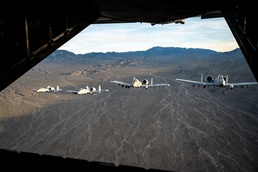
RENO, Nev. — Maj. John Miller, the 192nd Airlift Squadron director of operations with the 152nd Operations Group and pilots from the 66th Weapons Squadron, out of Nellis Air Force Base along with Combat Controller Team assigned Weapons Instructor Course participated in a joint training exercise in the Nevada Test and Training Range, this Thursday, February 26.
Miller, a C-130 pilot with the Nevada Air National Guard flew in coordination with A-10 pilots during a recent training event conducted within the Nevada Test and Training Range. The exercise emphasized integrated air operations designed to increase combat effectiveness and align with the Nevada Air National Guard’s ongoing focus on lethality and mission readiness.
“It was an honor to be part of this mission,” Miller said. “The A-10 has supported ground forces for decades, and working alongside the Weapons School pilots will always be something I take pride in. These instructors are among the best the nation has to offer on A-10s."
The training scenario involved simulated combat operations requiring close coordination between the C-130 and A-10 aircraft. The C-130 provided tactical airlift support while A-10 pilots executed close air support profiles in a realistic combat environment across the Nevada Test and Training Range.
The mission supported the Nevada Air National Guard’s continuing trend toward increased lethality — a focus on enhancing combat capability through realistic training and integration with advanced operational units. Exercises like this help ensure Air National Guard aircrews remain ready to operate in contested environments alongside active-duty forces.
Pilots from the 66th Weapons Squadron, part of the U.S. Air Force Weapons School at Nellis Air Force Base, used the training to refine tactics and strengthen integration with mobility aircraft. The complex training environment in southern Nevada provides unique opportunities for joint aircrew coordination under realistic conditions. According to Miller, the opportunity to work alongside active-duty Air Force units is essential to mission success.
The A-10 Thunderbolt II, commonly known as the “Warthog,” has served as the Air Force’s primary close air support platform for more than four decades and is scheduled for gradual retirement as the Air Force transitions to newer capabilities.
For Miller and the 152nd Airlift Wing, the mission reflected both the importance of total force integration and Nevada’s commitment to building a more lethal force through realistic training.
“Training like this is what prepares us for real-world operations,” Miller said. “Being able to contribute to Nevada’s lethality focus while flying alongside the A-10 community made this mission especially meaningful.”
Miller, who is also a weapons officer on the C-130 platform, emphasized the strong operational partnership between C-130 aircrews and A-10 pilots, noting that the aircraft’s similar airspeeds allow them to coordinate effectively during close air support and escort missions. He and several A-10 pilots agreed that the A-10 remains highly relevant on today’s battlefield, citing its precision, persistence, and ability to support ground forces in complex environments.
Miller noted that the last time a C-130 mission received A-10 escort support occurred in Afghanistan prior to 2015, underscoring the significance of renewed training between the two platforms.
The 152nd Airlift Wing regularly conducts tactical airlift operations supporting domestic and overseas missions, and continued integration with active-duty units ensures Nevada Air National Guard aircrews remain ready to support combatant commanders worldwide.