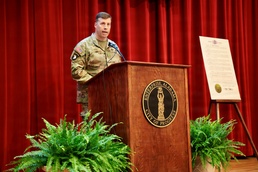
ENTERPRISE, Ala. -- Maj. Gen. Clair Gill, commanding general of the US Army Aviation Center of Excellence and Fort Rucker, outlined a significant transformation for the force, emphasizing a future with advanced unmanned aircraft and the acceleration of next-generation helicopters during a luncheon address on April 8.
Speaking to the Association of the U.S. Army (AUSA) at the Enterprise Civic Center, Gill detailed the impacts of the Army Transformation Initiative, a plan focused on modernizing the force.
"It has been a pivotal year for the Army, and for us at Fort Rucker," Gill stated, referencing the base's role as the "Home of Army Aviation."
As part of the initiative, Army Aviation is divesting from legacy systems, such as the AH-64D Apache helicopter and air cavalry squadrons, to free up resources. These savings, Gill explained, are fast-tracking the new MV-75 Future Long-Range Assault Aircraft, now expected to reach Soldiers in 2030, a year ahead of schedule.
"These changes are not just about cutting costs; they are about strategic reinvestment," Gill said. "By saving money on legacy systems, we can accelerate the future."
Gill, who recently assumed the new role of Portfolio Acquisition Executive for Maneuver-Air, also addressed the human element of this restructuring. He noted that while there was a reduction in authorized aviation positions, the Army took a "deliberate, talent-focused approach" to retain top personnel and offer voluntary transition options for others.
A major focus of the transformation is the growing importance of Unmanned Aircraft Systems (UAS), influenced by lessons from recent global conflicts. To meet this demand, the Army is creating a new military occupational specialty, 15X, by merging the roles of UAS operators and repairers. Training for this new specialty began in January.
"The future of warfare will heavily involve unmanned aircraft systems," Gill said. In response, Fort Rucker launched the Unmanned Advanced Lethality Course in October 2025 to create expert UAS operators. However, Gill stressed that manned aviation remains critical. "From the incredible heroism of the 160th Special Operations Aviation Regiment in Venezuela... to critical support missions on our southern border, our aviators in manned aircraft remain an indispensable part of the Army’s battlefield dominance," he said.
In preparation for the new MV-75 tilt-rotor aircraft, an Operational Development Team is being formed at Fort Rucker in July to develop tactics, training, and procedures.
Gill also highlighted Fort Rucker's significant local impact, noting it is the fifth-largest employer in Alabama with an estimated $9 billion annual economic contribution. He pointed to ongoing construction, including a new 320-soldier barracks complex set for completion in May, and a future battalion headquarters and dining facility.
He invited the community to the dedication of the CW4 Michael J. Novosel Soldier Service Center on Thursday, honoring the late Medal of Honor recipient who made Enterprise his home.
Gill concluded by thanking the local AUSA chapter and the Wiregrass community for their strong support. "Your kindness and hospitality make the Wiregrass a wonderful place for our soldiers to work, live, and raise their families," he said. "We could not do it without you."