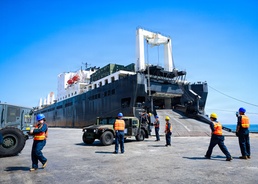
A Marine Corps technical assistance and advisory team deployed in March from Jacksonville, Florida, in support of a first-of-its-kind maritime prepositioning force offload in the Indo-Pacific region.
During offload preparation aboard the USNS Sgt. William W. Seay (T-AKR 302), the team assisted Marines in enclosed cargo holds, climbing over chained vehicles and gear. One by one, engines turned over. Exhaust curled into the pull of ventilation fans as each vehicle came to life—ready to roll off the ship.
Upon arriving at the Port of Cagayan de Oro, the team moved immediately into the selective offload of prepositioned equipment to I Marine Expeditionary Force, which was preparing for Exercise Balikatan 26 in the U.S. Indo-Pacific Command area of responsibility.
The offload marked the first time maritime prepositioning force equipment was delivered in Mindanao, expanding distribution capability and strengthening regional responsiveness.
Florida-based service members, civilians and contractors applied expertise in arrival and assembly, equipment accountability and distribution planning, informed by Blount Island Command’s execution of Marine Corps prepositioning operations ashore and afloat.
Robert Hazlett, contracting officer’s technical representative for Blount Island Command, worked aboard the ship and at the port alongside Marines receiving equipment. He joined Blount Island Command in 2024, where he ensures maintenance contractors execute their work statements.
“We’ve never done an MPF offload in this area,” said Hazlett, a Marine Corps veteran who served six years in motor transportation before transitioning to nearly 20 years as a contractor afloat on maritime prepositioning force vessels, including six years as a squadron supervisor.
That expertise enabled coordination across U.S. naval forces, the Armed Forces of the Philippines and commercial port partners, ensuring the successful reception and onward movement of equipment.
“Bringing this capability into a new location like Mindanao shows how we can extend the network”, Hazlet said, “using what’s already here, working with partners and still deliver ready-to-issue equipment where it’s needed.
“It proves we can expand into new locations and still deliver at high standards of readiness, building a more flexible, responsive network that supports the Marine Corps wherever it needs to operate.”
Marine Corps Platform Integration Center systems tracked equipment from ship to shore, providing real-time visibility of asset location, movement and arrival across each stage of distribution. Developed by Blount Island Command, the system uses digital tagging, sensors and integrated technologies to enhance accountability, readiness and distribution, improving the speed and precision of deployment.
U.S. Marines and Sailors executed the pier-side offload, integrating afloat prepositioning with host-nation infrastructure to move equipment where it is needed, when it is needed, without reliance on a single fixed distribution point.
This approach increases operational reach and flexibility while reinforcing the Marine Corps’ role as a naval expeditionary force optimized for contested logistics.
“MPF operations are a unique capability of the Marine Corps,” said Col. Coby Moran, I Marine Expeditionary Force officer in charge of the offload. “They allow us to deliver capabilities anywhere in the world, providing critical combat power to Marine air-ground task force commanders.”
The operation, supporting dynamic maritime sustainment, centered on the arrival and offload of the USNS Sgt. William W. Seay and demonstrated how forward-positioned equipment and integrated logistics networks enable forces to respond at the speed and scale required during crises and contingencies.
Months of coordination between port authorities, the Armed Forces of the Philippines and multiple Marine Corps commands culminated in the ship’s arrival at the Port of Cagayan de Oro.
“It’s been rewarding to see us develop those ties here with the local population and here with the Armed Forces of the Philippines,” Moran said.
Following arrival, Marines rapidly transitioned equipment from ship to shore and onto contracted host-nation barges for onward movement to Subic Bay, where it will be issued and employed by U.S. Marine Corps units participating in Exercise Balikatan 2026.
Balikatan is a longstanding annual exercise between the Armed Forces of the Philippines and the U.S. military designed to strengthen the alliance, improve combined capabilities and demonstrate commitment to regional security and stability. Beyond the exercise, the offload rehearsed the ability to surge sustainment in crisis or conflict.
By diversifying locations and leveraging local infrastructure, the operation increased the resilience of sustainment pathways while deepening relationships with Philippine military, government and commercial partners.
Equipment staged forward and maintained to standard reduces timelines for employment, enabling Marine units to transition quickly from reception and staging to onward movement and integration—key to supporting distributed maritime operations and joint maneuvers.
For more information, photos and stories about the offload, visit https://www.dvidshub.net/feature/Balikatan.