Story by: Sgt. Mary S. Katzenberger
BAGHDAD — In the cover of darkness one June evening a group of insurgents fired a number of rockets onto Camp Taji, Iraq. Everything went according to plan for the insurgents—except for the part about getting caught.
Unbeknownst to the insurgents, the 11th Iraqi Army Division had a strike force on standby ready to mobilize and detain the perpetrators. As soon as the attack occurred, and personnel in the Combined Division Operations Center at Joint Security Station Old MOD were notified, the strike force hit the road and soon detained the individuals presumed to be responsible for the attack.
In addition, evidence collected at the site of the attack, as well as information by the insurgents, led to the subsequent arrests of seven criminal associates from an indirect fire cell.
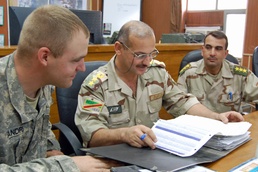
Capt. Leander Metcalf, intelligence officer with 3rd Battalion, 69th Armor Regiment, 1st Advise and Assist Brigade, 3rd Infantry Division, United States Division – Center, said the performance of the IA in response to these attacks represented significant progress in the way Iraqi Security Forces partnered with the battalion are executing intelligence operations.
Soldiers with 3rd Battalion, 69th Armor Regiment is responsible for advising, training and assisting the 11th Iraqi Army Division, the 9th IA Div. (Main), and the 9th IA Div. Tactical Action Center —collectively responsible for securing one-third of Baghdad.
Metcalf said at the beginning of their mission, the ISF, the battalion’s Security Transition Teams and intelligence analysts were already partnered and very effective at performing certain types of intelligence operations, but there was room for improvement.
For eight months, the battalion has tailored its training to focus on the processes involved in targeting potential suspects, conducting crime scene investigation and utilizing predictive analysis.
Metcalf said the goal of the training is twofold—for the IA to learn how to prevent attacks from occurring, as well as be able to react more efficiently in the event attacks are not mitigated.
To accomplish these goals, the intelligence training has been delivered through hands-on courses and training packages featuring modules on evidence collection procedures, document exploitation and human intelligence. In many areas of intelligence training, the ISF have recruited individuals from their own ranks to take over the teaching roles.
“We’ve started an initiative and they’re continuing to develop it the way they feel will best benefit them,” Metcalf said. “They take the model that we give them and they massage it so that it helps them accomplish their goals.
Lt. Col. Jeffrey Denius, commander of 3rd Bat., 69th Arm. Regt., said two recent ISF successes in particular highlight the vast improvements the Iraqis have made since the beginning of the partnership.
The first operation occurred during the 7th Imam Pilgrimage, an annual pilgrimage involving about1 million Shia Muslims to the Kadamiya Shrine. In preparation for the pilgrimage, ISF successfully acted on intelligence to adjust their security posture to better mitigate threats.
“With this [course of action], they resourced female searchers, they bolstered a couple of checkpoints and they reallocated some forces,” Denius said. “One of those checkpoints discovered six [improvised explosive devices].”
In addition, the enhanced security posture prevented a suicide bomber from inflicting as much damage as was likely intended.
Metcalf said since the 7th Imam Pilgrimage, the ISF have moved significantly using the analytical process to support operations. In preparation for the Muslim holy month of Ramadan, ISF spearheaded the development of a predictive analysis model and identified periods of high threat activities. Once again, the adjusted security posture has greatly improved threat mitigation in and around Baghdad.
“We’re seeing the fruits of our labor pay off,” Denius said. “More importantly, [the Iraqi Army is] seeing the fruits of [its] labor.”