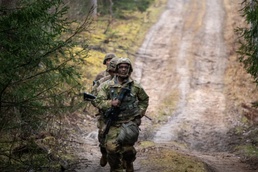
BEMOWO PISKIE TRAINING AREA, Poland — On the morning of the third day, I crawled out of my sleeping bag into a pitch-black forest blanketed in frigid air. “Jesus Christ” was the first thing I muttered under my breath to greet the freezing 40-degree morning. I felt like I was rising from the dead. Every bump, bruise, and cut became sparks of pain through my hips and back, and I began to doubt whether my legs would still carry me forward. Still, I kept my focus on one thing: ‘I would cross the finish line.’
I participated in a Spur Ride during my deployment to prove to myself that I could uphold my family’s legacy in the military and affirm my identity as a Soldier.
My path toward the spurs began with my dad. He served as a 1st Lt. in the New Orleans National Guard, and when he retired, he passed down several of his old patches. One stood out to me: a desert tan, five-inch long, rounded triangular Normand shield, a Cavalry Division patch. He had received the patch in Iraq while serving alongside the 108th Cavalry Regiment. At the time, I did not fully understand what it meant, but I knew it mattered.
About two years into my Army career, while attending Advanced Individual Training, I thought back to that patch and began researching its history. I learned about the role of the Cavalry and their traditions tied to the close-knit community, including the Order of the Spur. This cavalry tradition recognizes Soldiers who demonstrate proficiency, endurance, and commitment through events like a Spur Ride. That was when it clicked. I did not want to copy my dad’s experience. I wanted something of my own that still connected me to that same cavalry identity. Earning the spurs became my way of doing that and proving I had earned my place in the Army.
I had not always been confident in my abilities. Much of what I had done in the past was with others’ help, which made me question whether I was truly pulling my weight. Even in my public affairs role, which often kept me in the office rather than in the field, I did not always feel I was contributing as I should. The Spur Ride became an opportunity to test my mettle and see what I was really made of.
I started preparing as soon as we arrived in country by asking questions of those who had already completed a Spur Ride- known as ‘Spur Holders,’ as well as Cavalry troops who had been training for it. No matter who I asked, the answer was always the same: “Just survive. It’s not that difficult as long as you keep going.” While simple, the advice left me with more uncertainty than clarity.
I shifted my focus to physical preparation. I trained for endurance, twice a week I would ruck about five miles carrying a thirty-five-pound pack and incorporating dumbbell workouts to strengthen my hips and legs. Despite the preparation, I quickly realized that nothing could fully replicate the demands of the event. That became clear once the other spur candidates and I separated into our groups.
I was in group six alongside other Soldiers, many of whom were from non-combat roles, such as myself, the others were troops from information technology, supply, cooks, and medics. Our inexperience showed during the bag layout and the modified Army Combat Fitness Test. Because we are not all combat arms, our Army experience thus far has not been filled with weeks in the field and packing ruck sacks only to lay the items out in a certain way. Naturally, some of us were missing minor items and others were not getting the order of layout right. It was at this precise moment we started to glimpse what we were going to be going through. The modified Army Combat Fitness Test required twenty-eight hand-release push-ups, a two-minute plank, and a one-mile run within seven minutes. Fatigue had already set in before the event had officially begun.
Within the first few hours, the Spur Holders set the pace. After the initial events, we conducted a six-mile ruck march. Following a brief pause to eat and prepare, we were required to carry additional gear, including Meals Ready to Eat and a full case of water bottles. The added weight brought our load to fifty-five pounds, increasing both physical and mental strain.
The first day ended after we navigated to our next point in the dark. Our first lane required us to disassemble and reassemble a mortar system within seven minutes using only headlamps. Afterward, we were tested on Cavalry knowledge while continuing to perform physical exercises between tasks. Exhaustion had already started taking hold, and rest would only come after we rucked miles down the trail to our next point.
By 4:30 a.m. on the second day, the physical toll worsened, and yesterday’s wear and tare started to show its true colors. For me, the chafing had developed into raw, broken skin, and the constant movement was wearing down my legs. Some members of the group began to struggle to stay conscious as we attempted to navigate from point to point. Navigation errors forced us to retrace our steps multiple times, adding distance, compounding fatigue, and building frustration.
Thinking back now to those three days I know I stopped checking my watch or even trying to calculate where in the schedule we were. I just cared about when the sun would set so I could finally close my eyes.
We had made it halfway through the day when we approached the infantry lane in the wood line. There was no rest, only the mission in front of us. Our newest task for my team was to clear a bunker with two squads. I had the rare opportunity to take charge during the exercise, applying what I had learned and relying on input from other Soldiers to complete the objective. It was stressful because every decision I made affected how the team moved and cleared the bunker, and I did not want to be the reason we failed the lane. While my previous experience of being in charge of my platoon was during Basic Combat Training, this felt different. This time, I was leading in a more realistic environment, surrounded by Soldiers who expected me to lead even if I did not know everything. That pressure made it more challenging, but also more rewarding when we succeeded. It pushed me outside of my usual role and showed me how far I had come as a leader.
One of the most physically demanding lanes was the bayonet training lane. My team received our instructions from British Soldiers on how to employ the bayonet, both mounted on our weapons and in close-quarters combat, emphasizing aggression and control. After low-crawling to a target with the bayonet in an underhanded grip, we identified and attacked like wild animals, letting out blood-curdling screams as we charged the dummy target, tearing into it like beasts out of hell before scrambling out of the hole and running to the hills. At random intervals, each candidate had to drop into a fast low crawl at the command of “GRENADE” before continuing movement. This lane was my favorite because it was the most lethal. I really felt dangerous on this lane, and the best part was that we ended up adopting their motto: “What makes the grass grow? BLOOD BLOOD BLOOD. What’s the bayonet used for? KILL KILL KILL.”
During the “tunnel of love,” each member held a high-centered push-up position while others crawled underneath, often through mud, adding to the physical strain. I hated that event. We did it at nearly every lane. We did seven lanes. At this point I started playing mind games with myself so I would always try to be last, knowing that once I made it through, it was over. But by the end, especially after the pugil stick lane, it meant dropping back into the mud just as we had started to dry off. It left us soaked, cold, and exhausted all over again.
Our final challenge was the Spur Board, where we were tested on Cavalry knowledge and required to recite the “Fiddler’s Green,” a traditional Cavalry poem that describes an afterlife for fallen troopers. The climactic end of a terribly tough day my team went inside the dimly lit command tent, to prove ourselves worthy of the Cavalry’s infamous silver spurs. It was quiet as we lined up before the command table and then the flap closed and we threw our heads back and let our exhausted raspy voices let loose a thunderous cry, “Halfway down the trail to Hell, near a shady meadow green are the souls of all dead troopers camped near a good ol’ time canteen, and this eternal resting place is known as Fiddler’s Green!”… We ran out of the tent with psychotic smiles plastered to our faces, fully confident we had made it.
For now, we got to revel in the silent satisfaction that our lanes were all but completed. Except… we still had one final task. The Spur Holders gave us actual time to sleep before the final movement.
In all honesty, it was probably some of the best sleep I had gotten since the event started. That quickly changed the next morning.
We woke at approximately 04:30 a.m. to begin the five-mile movement back to the parade field. It was still pitch-black, and the cold air was visible with each breath. As I stood up, every bit of pain I had pushed aside in the previous days came rushing back. My legs were stiff, my hips felt locked, and the chafing on my skin had worsened to the point where every step burned.
We tried to move in a semblance of a formation, but it quickly fell apart. One of the Soldiers in our group was struggling to walk, so we took turns lifting his rucksack off his back just to keep him moving forward. At that point, it was not about doing it perfectly. It was about finishing together.
This event was the closest I came to quitting. My legs felt worn down, and every step required effort. I shifted my mindset and reminded myself that everyone around me was experiencing the same struggle. We just had to keep moving forward.
I kept thinking my legs were going to give out. The cold cut through everything, and we had no choice but to feel it as we shuffled forward. Every step felt like a fight just to stay upright.
When we finally reached the parade field, the Spur Holders directed us to set our equipment down and rest. I removed my gear and sat on the pavement, unsure if I would be able to stand again without assistance. Despite the doubt, my group and I had made it through.
After the movement, we turned in our equipment, including our pro-masks, night vision devices, and the M4A1 rifles we carried throughout the event. As I handed mine in, the commander of Annihilator Company, 3rd Squadron, 8th Cavalry Regiment. He handed me his company coin. He recognized my effort throughout the Spur Ride and gave me something I will never forget. He said I impressed him with my enthusiasm, and he said the coin represented that I was an honorary member of the Annihilators.
That moment meant more than I expected. I was not part of their unit, and I had not even trained with them, once. But I had gotten the unique opportunity to step into their world, endure the same experiences, and earn their respect. For the first time in my career, I felt like I truly belonged to something I had been chasing since I first saw that patch.
Thankfully after a few hours rest, we finally changed into clean uniforms and went to the ceremony site. Our last and final task.
To receive our spurs, we were placed, once again, in the front leaning rest position while Spur Holders attached the historical symbol outwardly proving we had each earned them with our blood, sweat, and tears solidifying our induction into the Order of the Spur.
At that moment, I felt a sense of accomplishment. I had set out to prove something to myself, and I had. However, the experience also taught me something more important.
I realized that I had not made it through the Spur Ride alone, from my first sergeant, who encouraged me to participate when I first brought it up, to my sergeants, who helped me prepare, to the Soldiers who were part of my group during the Spur Ride, who pushed forward alongside me, supporting one another every step of the way.
I learned that I could only build success through shared effort, support, and perseverance.
‘One Team, One Fight,’ or better yet, Honor and Courage!’
-30-