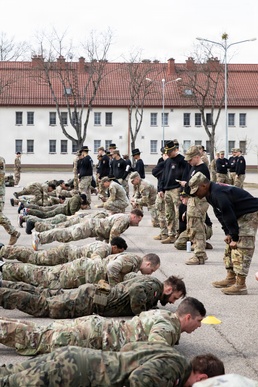
BEMOWO PISKIE, Poland – "One of the things I wanted to do to really build a team was include all of our allies and to give them an opportunity to experience a unique tradition in the U.S. Army," said U.S. Army Lt. Col. John Nimmons, commander of 3rd Battalion, 8th Cavalry Regiment (3-8th CAV) and the NATO Forward Land Forces (FLF) Battlegroup-Poland.
The Spur Ride, a time-honored tradition, came to Poland March 25 to 27, 2026, at Bemowo Piskie, and not only did U.S. Army Soldiers get to experience this unique cavalry tradition of earning Spurs, but also Romanian, Croatian, British, and Polish soldiers.
The battlegroup, composed of the U.S., Romanian, Croatian, and British soldiers, has spent the past seven months training together on a range of military readiness skills.
"Combat is going to be harder," said Nimmons. "So, if I can train as tough and as hard as I can now, it instills that don't quit attitude under the basic conditions, under the basic tasks that I need you to do. You're going to succeed in combat."
Not only did the Spur Ride contribute to the 3-8th CAV Soldiers’ readiness, but it also contributed to the cohesion of the battlegroup.
"I would never be able to do this anywhere else, so it's been a really good experience," said Cpl. Joshua Wardman, Joint Terminal Attack Controller, British Army, 2nd Battalion Royal Anglian Regiment.
In addition to what the Army calls "smoke sessions" to start their first day, a tactic used to mentally and physically test limits in order to teach their teams discipline and endurance under stress, soldiers of the battlegroup completed hand-release push-ups, a plank, a one-mile run, and a six-mile ruck march.
"It was pretty rough and grueling," said Wardman, "all about team bonding."
Ten teams of almost 20 soldiers from the U.S., Poland, Croatia, Romania and England made their way to the Bemowo Piskie Training Area as the sun went down and night-vision goggles were put on.
Ending their night, they completed one of ten lanes, set up their sleeping systems, held guard nightshifts to wake up at 4 a.m. to an assault.
By five o'clock, all teams were at their next lane. The lanes consisted of training in medical, vehicle recovery, bayonet, bunkers, Flakpanzer Gepards, chemical, biological, radiological, and nuclear, call for fire, gunnery skills test, unit history, and pugil sticks.
Later, as night was shortly upon them, all teams headed to the main command post for their spur board. The candidates were asked to recite the "Fiddler's Green" also known as the Cavalry’s Poem, which is deep within the cavalry’s tradition, and answer questions about the history of the cavalry by three senior spur holders.
At the main command post, Nimmons and his two other senior spur holders had to vote on whether the spur candidates had passed the test.
Almost complete with the Spur Ride, in which candidates spent one more night in the woods, woke up early, and rucked back to base, where the majority of those who started would become Spur Holders. Unfortunately, 32 of the 214 were unable to complete the Spur Ride’s physical and mental tasks.
Of the training, 2nd Lt. Micha Grohowshki, 5th Territorial Defence Forces, Polish Armed Forces, said jokingly that he "liked it very much...great place for a nervous breakdown."
The Spur Holders from the 3-8th CAV at Bemowo Piskie, Poland, did an exceptional job testing the strength of the soldiers of the battlegroup and the local Polish soldiers.
The U.S.-led battlegroup at Bemowo Piskie is part of the Eastern Defensive Forward Initiative, intended to create deterrence and a defensive posture in Poland.
Nimmons said, "Everything we do is important. You don't know what's going to happen, and you just have to be ready. This is a good way of showing how ready we are."