U.S. Navy researchers at Wright-Patterson Air Force Base are looking for volunteers to help support a study directly supporting one of the United States’ biggest space exploration goals: returning American astronauts to the Moon.
The Naval Medical Research Unit (NAMRU) Dayton researchers, working with the Air Force Research Laboratory’s 711th Human Performance Wing (711th HPW), Johns Hopkins University School of Medicine, and NASA’s Human Research Program, are conducting a collaborative study examining motion sickness and how the human body adapts to acceleration and changing gravity environments. Volunteers will help scientists better understand how the brain and inner ear respond to motion and to space motion sickness mitigation techniques that could improve both military aviation safety and astronaut performance in space.
The study, StableEyes With Active Neurophysiology Monitoring (SWAN), has been underway for several years and requires volunteers who have both a current aviation medical clearance and Tricare health insurance coverage, due to the challenging nature of the motion profile.
“The participants’ physical readiness for the unique aspects of the centrifuge exposure coupled with the need to have reasonable astronaut analog subjects is key,” said Rich Folga, NAMRU Dayton’s project manager for the SWAN study. “Having an aeromedical clearance notice from a competent flight medicine examiner ensures candidates have ‘the right stuff.’ Our mandate for greater than minimal risk studies is that our subjects also need to have Tricare health insurance coverage. Additional subject screening is done to ensure the candidate is a good match for target study population based on their self-reported sensitivity to provocative motion stimulus.”
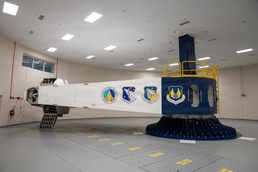
First, the participants experience controlled acceleration profiles in the 711th HPW’s centrifuge simulating spaceflight deconditioning effects on key balance and coordination systems. After the centrifuge run and while experiencing this temporary deconditioning effect, volunteers perform a series of tasks while wearing goggles that track head and eye movements, capturing measurements associated with motion sickness. The entire group will complete additional tasks testing balance after the deconditioning events.
This research is part of a broader effort to develop countermeasures that will help astronauts remain safe and effective during future lunar missions under NASA’s Artemis program.
“Dayton has been at the center of aerospace medicine for decades and aerospace in general since the invention of the aircraft,” said Dr. Richard Arnold, director of NAMRU Dayton’s Naval Aerospace Medical Research Laboratory (NAMRL). “Naval medical researchers at the lab contributed to astronaut training and physiological research during the Mercury, Gemini, and Apollo programs. This collaboration continues that legacy by bringing together Navy, Air Force and NASA scientists to solve challenges that will help enable future missions to the Moon, and beyond.”
Wright-Patterson Air Force Base is home to the nation’s premier aerospace medicine research center, where scientists from the Navy and Air Force collaborate in support of joint missions in addition to supporting broader national priorities such as the ongoing collaboration with NASA and related research that affects both military aviation and future human space exploration. The Air Force’s centrifuge has recently supported astronaut training and research tied to NASA’s Artemis lunar exploration program, which aims to land astronauts on the Moon and establish a sustained human presence there later this decade. NASA’s Artemis campaign is designed to return American astronauts to the lunar surface for the first time since 1972. The program’s first mission, Artemis I, successfully completed an uncrewed test flight around the Moon in 2022. The crewed Artemis II mission launched on April 1 and saw the crew travel further from Earth than any humans in history as they looped the moon while spending 10 days in space.
For astronauts traveling to the Moon, the body must transition between Earth gravity, microgravity during transit, and the Moon’s partial gravity, conditions that can create sensory conflicts in the vestibular system — the inner ear structures responsible for balance and spatial orientation. Studies like the one underway in Dayton help scientists develop techniques and technologies that allow astronauts to adapt more quickly to these conditions.
Volunteer information: Participants will complete up to eight hours of testing across two days, including exposure to a 3Gx acceleration profile inside the 711th HPW centrifuge and a series of balance and vision assessments. Volunteers may receive compensation in gift cards across the two sessions, with an additional gift card for wearing a 24-hour activity monitor. Active duty and federal employees must be on leave or in an off-duty status in order to be eligible for monetary compensation. Experimental stress hazardous duty incentive pay will be available to on-duty military participants.
Qualified participants must: · Be active-duty military or a TRICARE beneficiary · Be between the ages of 18 and 55 · Be between 5’0” and 6’4” in height · Weigh between 88 and 245 pounds · Have a current medical clearance (DD2992, FAA 8700-2, or FAA 8500-9) prior to the second study session · Not have been exposed to centrifuge training in the past 72 hours · Not be susceptible to moderate-to-severe motion sickness · Meet additional study criteria
Those interested in participating can contact the research team at: mailto:NAMRU.DRD.Scheduling@us.af.mil
NAMRU Dayton, part of Navy Medicine Research & Development, participates in medical research and development efforts dedicated to advancing warfighter lethality by protecting and enhancing health, readiness and performance through cutting-edge toxicology, environmental health and aerospace medical studies.