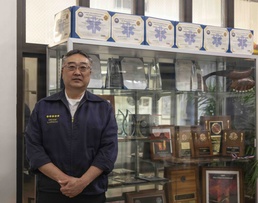
Gregg Moriguchi helped build the emergency medical services (EMS) program for Commander, Navy Region Hawaii’s (CNRH) Federal Fire Department (FFD) from the ground up.
When he joined the FFD in 2000 after working as a paramedic for the City and County of Honolulu, the department’s EMS capability was limited. Moriguchi was one of six paramedics tasked with building the EMS program.
“Under the leadership of then Fire Chief Michael Jones and EMS Chief Dennis Yurong, I helped identify program requirements, worked with medical directors to establish treatment protocols, and developed operating procedures for the department’s EMS program,” recalled Moriguchi.
By the time Jones retired in 2005, CNRH’s FFD had the most comprehensive EMS program in Hawaii responsible for providing fire and emergency services to the military across multiple installations, ultimately serving as a model for development of EMS programs throughout the Navy shore enterprise.
“When the Marine Corps and the Army approached us about establishing an ambulance service to the same level of our Federal Fire Department, that gave me the validation that we were moving in the right direction,” he said.
Moriguchi became regional fire chief of CNRH's FFD in September of 2015.
Today, under Moriguchi’s oversight, the FFD’s EMS program has grown from one ambulance and six paramedics to operating four advanced life support ambulance units with 24 paramedics serving Navy, Air Force, Army, and Marine Corps installations on Oahu.
Moriguchi said working as a paramedic for the City and County of Honolulu taught him how to operate in a fast-paced environment with often unpredictable workloads.
“In this career field, my prior experience working with patients taught me to develop resilience, persistence, and the desire to get the job done,” said Moriguchi. “And I think that translated well into my position here in management and administration.”
He also said that having experience as a firefighter on Oahu helped him better understand people.
“I grew up on Kauai where the general population is lower but working as a firefighter and paramedic on Oahu with the higher population density, I was able to see more people, respond to a variety of calls, and experience different types of medical incidents and life experiences,” said Moriguchi.
Reflecting on his 26 years at Navy Region Hawaii, Moriguchi explained that adaptability is the most important lesson he's learned.
“I’ve learned that applying a single approach does not work for every patient or every incident,” said Moriguchi. “You have to learn to be flexible by having empathy for those in need and sometimes put yourself in their shoes. I think being here has helped me understand that a lot better.”
Moriguchi stressed that the biggest challenge he faces today is managing resources to ensure the department is appropriately staffed and that personnel have the tools and capabilities to be effective after their initial training period at the Hickam Fire Training Facility, where they receive more than 1,100 hours of class and hands-on training and 240 hours of emergency medical technician training.
“Firefighter trainees learn about fire behaviors and firefighting techniques, hazardous materials and response operations, different types of rescue situations, emergency medical care, incident command systems, and through training come to trust in each other’s abilities,” said Moriguchi. “Firefighting is inherently dangerous and requires firefighters to maintain physical conditioning and performance to safely and effectively perform their duties.”
Moriguchi said even after graduating, firefighters continue to learn new skills to stay current in their field. During emergencies, all those hours of training enable firefighters and paramedics to quickly adapt to whatever they face, he said.
“The training that firefighters go through as EMTs prepares them to deal with stressful situations,” said Moriguchi. “The first time you find yourself in that kind of situation it’s scary, it’s exciting, and you get a range of emotions all at once.”
Moriguchi said there are some aspects about firefighting that the general public might not be aware of.
“I think what the public may not necessarily understand is how dedicated the firefighters are,” said Moriguchi. “We can see that when they first come into the job and as they progress into their career, they get better at what they do. They learn new skills and they keep up the knowledge and the expertise that’s required, and that takes a lot of effort and commitment.”
FFD receives an average of 5,500 calls per year; about half of those calls – some 2,500 to 3,000 – are EMS calls. Moriguchi explained that with the sheer volume of calls, his firefighters and paramedics have grueling schedules, requiring them to be on-call around the clock.
“The fire and emergency services profession requires our firefighters to be ready to respond to unplanned, uncontrolled, and chaotic situations at all hours of the day,” he said. “In our line of work, sometimes we don’t know what’s coming or what that next call is going to be, so we always have to be ready to adapt to the situation.”
Although not without its challenges, Moriguchi said being a firefighter is rewarding because it provides the opportunity to make a difference in people’s lives.
“The most rewarding aspect of being a firefighter is helping the public when they need you the most,” he said. “I’ve recognized that as a result of our actions, whether it be fighting fires or providing medical care to whoever is in need, we get to see how appreciative people are of the help and service that we provide, and I think that’s what makes it all worth it.”