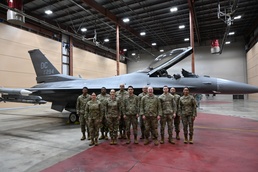
JOINT BASE ANDREWS, Md. – At any minute, the alarm can sound at the 113th Command Post at Joint Base Andrews. In a building where staff and F-16 pilots sleep in on-site quarters during their 48–72-hour shifts, they can be jolted awake and ready for action if need be. Pilots and maintainers have had meals interrupted, showers cut short, and dreams quickly shaken off as they run down the halls to their assigned areas. The pilots run to their jets, the maintainers run to support, and all work together to respond to whatever threat there is in the sky.
The alarms are set off by a team that is always manning the desk and phone – the 113th Command Post. Every hour of every day, these controllers are constantly monitoring the airspace from their desks in a secure area. While they also work in shifts, someone must be awake at all times. Once they receive a call from the Air Defense Sector, their role is to ensure the team is notified into quick action. The klaxon sounds and the words “scramble, scramble” continuously echoes throughout the facility, and the response team quickly springs into action.
The Command Post originally stood up in September 2001, in response to the tragic events when the D.C. airspace was breached and over 100 lives were lost when the Pentagon was struck. Since then, over the past 25 years, the team has responded to over 8,000 incidents. In this fiscal year alone, they have responded to over 100 real world postures. They also conduct two practice scrambles a week, ensuring the pilots keep their skills sharp and their attention alert.
Their commitment to excellence in their mission was recognized this year as the 2025 Continental Northern American Aerospace Defense Command Region (CONR NORAD) Aerospace Control Alert (ACA) unit of the year as well as winning the Small Installation Command and Control (C2) Operations Node of the Year. The 113th Command Post has had a legacy of winning various awards over the years.
“The foundation of the Command Post winning legacy is the controllers,” said D.C. Air National Guard Master Sgt. Ismari Ramos-Medina, Superintendent of the Command Post. “As they grow in rank or roles, they learn to be dynamic in unknown situations and to be experts at utilizing operational judgement combined to carry out the mission. More importantly, they develop the grit to get the mission done. The legacy this group of controllers leaves behind is unparalleled and only aims to inspire others to be the same way.”
The 113th Command Post achieved the highest possible rating on their Alert Force Evaluation, while also pioneering an AI-powered data management system and raising over $20,000 to benefit local communities.
“We can literally pinpoint a contribution from every single controller,” said Ramos-Medina. “Not just a few, butallcontrollers made major contributions to the CP and the Wing through their respective programs. Without the unique and intertwined contributions of all controllers, the 113 CP would not have distinguished itself as it did.”
“Our Command Post team is a mix of prior controllers and cross trainees,” said Master Sgt. Abiezer Diaz Resto, C2 Operations. “Half of the team comes from mission support, medical, maintenance and operations and the rest are expert emergency actions controllers, and it is a multigenerational space as well, which becomes a true recipe for success. You'll find a mix of seasoned veterans with years of experience and new airmen eager to learn.”
The Command Post does commonly accept airmen from different career fields, requiring Airmen with technical expertise and critical thinking skills.
“Every day in the CP is different, with all shifts exposed to new situations that contribute to building a comprehensive C2 skillset,” said Ramos-Medina. “The 113 CP is primarily known for the Aerospace Control Alert mission, which serves as the initial focus for new team members. Controllers expertly carry out this mission within three to six months of arriving. However, becoming a well-rounded, expert-level controller who can handle both day-to-day operations and unforeseen situations can take up to three years.”
“The events vary in intensity – one minute you could be handling a routine aircraft maintenance issue, the next you're at the forefront of a major emergency response,” said Diaz. “While the initial technical school is relatively short, the real learning happens on the job.It typically takes a few months of intensive on-the-job training before a new controller is comfortable running the console while supervised. However, true proficiency, the kind that allows you to anticipate issues and react instinctively, can take years to develop.”
“The team dynamic in a Command Post is one of camaraderie. You must rely on the person sitting next to you without hesitation,” said Diaz.
“There is a deeply ingrained understanding that there is no room for error when lives and mission success are on the line,” said Staff Sgt. Alberto Matos Fernandez, C2 Systems. “We don’t just support each other; we operate with a level of trust and synergy where we can anticipate one another's needs, especially under pressure. When one controller is handling a high-stress event, others are proactively cross-checking procedures, preparing for the next likely step, and ensuring no detail is missed. We are always looking for ways to improve ourselves and elevate the performance of the entire team.”
“If anyone happens to stumble, there’s always a teammate to pick them back up,” said Staff Sgt. Christian Jenkins, Emergency Actions Controller. “The ‘no-fail mission’ applies for both protecting the National Capital Region as well as looking out for each other.”
The 113thCommand Post competed against seven other alert facilities, and Master Sgt. Ismari Ramos-Medina also won C2 Operations SNCO of the Year for the 2025 ANG C2 Operations Annual Awards.