By Ann Brandstadter
Walter Reed Hospital Communications
Occupational Therapy (OT) plays a critical role in warrior readiness, focusing on optimizing physical, cognitive, and emotional function to maximize performance and expedite return-to-duty.
Walter Reed National Military Medical Center is home to one of the largest OT clinics in the nation, and its mission is to promote and facilitate functional independence, healthy living, return to duty, and optimal performance in activities of daily living for patients.
U.S. Army Col. Enrique Smith-Forbes, chief of Occupational Therapy in the Department of Rehabilitation at Walter Reed, explained the focus and goals of OT at the medical center. “In OT, we evaluate and develop treatment plans for active-duty service members and Department of War beneficiaries with severe limb trauma [and] amputations,” he said.
“We see a variety of upper extremity soft-tissue injuries, such as tendonitis and carpal tunnel, and post-surgical cases [including] fracture fixations, tendon repairs [and] replantation surgery in the OT/Orthopedic Hands and Upper Extremity section,” he added.
Walter Reed’s OT team uses a comprehensive spectrum of care to address limb trauma and amputation, upper extremity injuries and challenges, and cognitive and mental health concerns.
To address limb trauma and amputation, OTs develop specialized plans focused on adaptation and regaining mobility.
OTs work alongside orthopedic surgeons to treat complex hand and arm injuries, ensuring service members regain the dexterity needed for both daily life and their military duties.
OTs also provide vital rehabilitation for traumatic brain injuries (TBI) and combat stress, ensuring that "readiness" includes mental and emotional resilience.
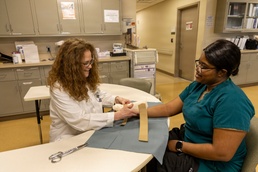
Joan Margulies is a Walter Reed OT who specializes in upper extremity injuries. For Margulies, who has been a licensed OT for over 35 years, the work is deeply personal.
"I find making a difference in patients’ lives the most rewarding part of my career," Margulies shared. "The transformation of my patients is inspiring for me."
OT patients aren't just recipients of care; they are active participants in a rehabilitation process that includes custom bracing, splinting, and innovative therapies. “I evaluate and treat various levels of complex diagnoses, working closely with orthopedic hand surgeons to ensure they are given the highest level of care with pre-op or post-op treatment,” said Margulies, who is also an expert brace and splint creator.
The reach of Walter Reed’s OT clinic extends to the entire military community, including retirees and families, offering services such as assistive technology, low vision care, and intimacy counseling.
With a scope that ranges from inpatient acute care to outpatient ergonomics and research, the Walter Reed OT clinic remains a cornerstone of military medicine. As it continues to mentor the next generation through its Occupational Therapy Doctorate (OTD) Internship, the clinic ensures that the future of the force remains as strong and capable as those who serve it.
For more information about Walter Reed’s world-class occupational therapy services, visit https://walterreed.tricare.mil/Health-Services/Specialty-Care/Occupational-Therapy.