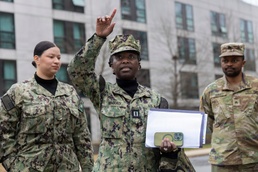
When injured active-duty service members need to get from the battlefield to critical medical care back home in the U.S., the Medical Evacuation (MEDEVAC) Department for Walter Reed National Military Medical Center plays a vital role.
“Walter Reed’s MEDEVAC team is responsible for supporting patient movement across the globe while ensuring patients receive presidential care during transport throughout the Aeromedical Evacuation System,” said U.S. Navy Lt. Abena Nimako, Officer in Charge of the MEDEVAC team. “In addition to inbound and outbound military personnel from all branches requiring transport, the MEDEVAC team also supports the movement of reservists, veterans, beneficiaries and dependents for care.”
The MEDEVAC team supports the Defense Health Network-National Capital Region’s patient movement requirements as directed by the Department of War. The team coordinates and synchronizes various movement plans with U.S. Transportation Command Global Patient Movement Requirements Center, the European Command Theater Patient Movement Requirements Center, the Deployed Warrior Medical Management Center at Landstuhl, Germany and the USAF Aeromedical Staging Facility to ensure a seamless transition of patients transferring to and from the NCR.
The MEDEVAC team is composed of dedicated officers and enlisted personnel from the Navy, Army and Air Force including registered nurses, paramedics, medics and corpsmen. The primary team consists of 14 active-duty personnel, which includes one nurse officer who serves as the mission nurse and the officer in charge of the department, currently filled by Nimako; one patient care coordinator; one non-commissioned officer in charge and 11 corpsmen. There is also a rotational team comprised of nine active-duty enlisted personnel and two registered nurses that operates on a two-month period to provide relief for the primary team.
The team uses a variety of vehicles to transport patients and team members to and from the pick-up/drop-off locations, including ambulances, patient evacuation vehicles which function as intensive care units on wheels, an ambulance bus, a separate luggage truck and a nine-seater van. The team is equipped with critical lifesaving/preserving equipment, including defibrillator units, IV kits, a blood infusion system, oxygen tanks, wound vacuums and other vital patient care supplies. In addition to the medical staff, the team also includes three professional drivers who operate the large vehicles required to carry the medical staff and sizeable pieces of equipment necessary to safely transport patients.
A “typical” mission begins far from Walter Reed, with the initial stabilization and transport of wounded or critically ill service members from a combat zone conducted by air MEDEVAC units.
“Once stabilized at an overseas hub, the patient is then flown back to the United States to various destination airfields in the National Capital Region,” said Nimako.
Walter Reed serves as a critical receiving and continuing care facility for service members (and sometimes their families or allies) who have already been medically evacuated from an operational theater. The MEDEVAC team meets the incoming patients at their destination airfield, transitioning them into patient care vehicles to ensure uninterrupted quality of care. An average mission involves transporting between 8 to 10 patients, but the team has the capability to carry as many as 26 patients on litters or upwards of 42 ambulatory patients.
Once the patients are secured in the vehicles the MEDEVAC team continuously monitors their condition, administering any needed care during the trip to Walter Reed. At each stage of the process, the MEDEVAC team remains in contact with base operations for Walter Reed, base security forces, service-specific liaisons and Walter Reed staff, depending on the nature of the patient’s medical situation. Staff at Walter Reed will also inform patients’ families of their imminent arrival so they can be present to support their loved ones.
At Walter Reed, patients are transferred into the care of the specialized unit depending on their care needs – Intensive Care, Orthopedic, Gastrointestinal or other treatment type. Each handover involves a detailed report of the patient’s condition.
“’Thank you’ is not what I am looking for,” said Nimako. “The real validation is when the mission is secured and the patient is at Walter Reed. I tell myself that I made a difference that day. I did something good.”