FORT BELVOIR, Va. – The need for global security is always evolving, and the Joint Science and Technology Office (JSTO) is leading the development of the latest innovations to defend our warfighters and our nation against chemical and biological (CB) threats.
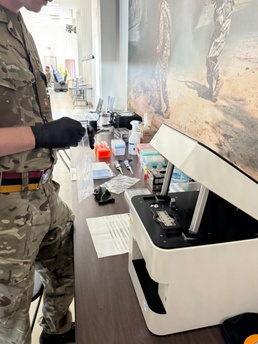
This approach, described as "Shield and Spear," represents a move away from traditional reactive strategies by focusing on broad-spectrum tools that can be quickly deployed to reduce the impact of unknown agents, allowing more time to develop targeted defenses. A key component of this strategy is field-forward untargeted metagenomic sequencing, a revolutionary technology currently being evaluated in exercises with military operators.
"Untargeted sequencing gives us an unprecedented ability to see the full picture of what we're dealing with in a clinical or environmental sample," said Stephanie Calderwood, branch chief for the Diagnostics Medical S&T Division at DTRA JSTO. "Instead of looking for a specific pathogen we already know, we are casting a wide net to identify any and all microorganisms. This is the foundation of modern bio-deterrence, providing us with an early warning and characterization capability second to none.”
While the "Shield" provides the first line of defense, the "Spear" is designed to rapidly develop, test and deploy highly targeted diagnostic tools as soon as a new biological threat is detected. JSTO's investment in expeditionary, on-demand development will revolutionize battlefield medicine, moving from a slow, cumbersome process to a rapid, automated "sample-to-assay" workflow. The process culminates in porting the newly developed assay onto existing, fielded molecular diagnostic devices, ensuring the capability can be rapidly deployed to the warfighter without the need for entirely new hardware.
"Our goal is creating a fully integrated, threat-centric diagnostics hub that can go from a sample to a deployable diagnostic assay in a matter of hours, not weeks," Calderwood explained. "We are doing this by automating the workflow and integrating top-tier commercial technologies. This allows our field medical units to produce their own diagnostic tools on-site, which is critical in contested environments."
This forward-leaning strategy is not theoretical; it is actively demonstrated through exercises aligned with U.S. Indo-Pacific Command and the Office of the Deputy Assistant Secretary of War priority efforts. The Dragon Medic initiative, JSTO’s expeditionary diagnostic manufacturing capability, is being tested at major exercises, proving that rapid, on-demand assay development is a reality.
Diagnostics newest advancements are powered by machine learning, artificial intelligence (AI) and high-performance computing. This technology enables JSTO to build a digital backbone that transforms medical countermeasures through AI-driven pipelines. This changes the process from a slow, sequential one into a rapid, predictive and integrated system. While this approach will benefit the entire countermeasure landscape, the impact on diagnostics is particularly profound. By using machine learning and AI, JSTO can accelerate everything from the initial identification of a medical threat pathogen to the automated manufacturing of diagnostics at the point of need. This is exemplified with SPADES (Sequence-based, Pathogen Agnostic Computational Biological Agent and Detection and Diagnostics Solution), which uses a curated database of unique signatures and machine learning to quickly identify unknowns in a metagenomic sample.
"Machine learning and AI are a critical enablers for our 'Shield and Spear' strategy," Calderwood stated. "AI allows us to break down information silos that have historically hampered development and establish a cohesive data ecosystem. This allows our AI and machine learning tools to access the datasets needed to deliver solutions faster."
As with every effort of this magnitude, partnership is important. JSTO is developing a vast system of partners from government, industry and academia. By working with organizations such as the U.S. Food and Drug Administration (FDA) and Advanced Research Projects Agency for Health (ARPA-H), JSTO ensures its innovations are not just scientifically sound but also coordinated with regulatory pathways and scalable processes.
Through integrating untargeted sequencing, expeditionary manufacturing and advanced computing, JSTO is forging a new era of medical diagnostics.
"The future of conflict demands a new generation of medical diagnostics—one that is as agile and flexible as the threats our warfighters face," Calderwood concluded. "We are not just responding to emerging requirements; we are forging the shield and sharpening the spear to ensure the Joint Force remains ready, resilient and victorious on the battlefields of tomorrow."
To learn more about the Joint Science and Technology Office (JSTO), follow the organization on LinkedIn at linkedin.com/showcase/dtra-jsto.