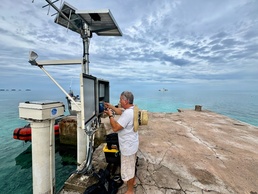
SANTA RITA, Guam— The crew of the USCGC Oliver Henry (WPC 1140) returned to Guam on March 29, closing out a 29-day patrol period that restored a critical tsunami early warning station on a remote Pacific atoll, delivered humanitarian supplies to two island communities, and enforced fisheries laws across more than 4,000 nautical miles.
The patrol under Operation Rematau covered U.S. waters in the Commonwealth of the Northern Mariana Islands, Guam, and the Federated States of Micronesia.
"The Coast Guard's credibility in this part of the Pacific is built one port call, one boarding, one supply delivery at a time. This patrol, from the fisheries enforcement work in FSM's EEZ to getting that NOAA technician to Kapingamarangi, is exactly how we honor the commitments the United States made to the people in this region. I'm proud of how this team delivered on that responsibility," said Lt. Ray Cerrato, commanding officer of USCGC Oliver Henry.
The mission's most consequential stop came at Kapingamarangi Atoll, one of FSM's most isolated communities. The Oliver Henry crew transported a University of Hawai’i Sea Level Center technician to the atoll to upgrade a regional weather monitoring station, the first such upgrade in 12 years. Supported by the U.S. Embassy in the FSM and the National Oceanic and Atmospheric Administration, the mission restored the station's capacity to support tsunami early-warning monitoring across the Western Pacific.
The station’s importance came into sharp focus days after Oliver Henry returned to Guam. On April 2, a magnitude 7.4 earthquake struck in the Molucca Sea, prompting the Pacific Tsunami Warning Center to issue a threat forecast for coastal communities across the Western Pacific, including Guam, the CNMI, Palau, and Yap. The Kapingamarangi gauge was online and transmitting when the event occurred, ready to contribute observed sea level data to the warning center’s analysis.
The earthquake’s distance meant tsunami generation was minimal and not detectable at the Kapingamarangi station, but the network it supports held. The PTWC team confirmed the station is one of a small number of sensors covering that stretch of the Western Pacific and that its restoration directly maintains the readiness network the warning center depends on.
The crew conducted three fisheries enforcement boardings of foreign-flagged vessels, two Western and Central Pacific Fisheries Commission inspections on the high seas, and one enhanced bilateral boarding of a vessel under the FSM's jurisdiction in their EEZ, directly advancing accountability under local and international laws in a region where illegal fishing is estimated to cost Pacific nations billions annually.
At Kuttu and Kapingamarangi, the crew delivered 3,000 pounds of humanitarian supplies to residents with limited access to outside goods. The crew also provided Chuuk State Government officials with high-quality imagery documenting the condition of a cargo vessel that grounded on the reef outside of Kuttu Island in the Mortlock Islands in 1998 and has been deteriorating since, supporting local government response efforts.
The patrol expanded the Coast Guard's operational reach for future missions. The crew charted previously unrecorded reefs within Greenwich Pass at Kapingamarangi, establishing a navigable route into the atoll's lagoon for future operations. The Oliver Henry crew also transported Marine Safety Unit Saipan personnel to Tinian and Rota for inspections of port facilities, streamlining logistics, and ensuring the safe flow of goods throughout the CNMI.
During the 395 operational hours underway, the crew improved readiness by qualifying members in roles ranging from underway officer of the deck to engineering officer of the watch while also honoring nautical traditions with one member earning their permanent cutterman designation and six shellback designations during the patrol's equatorial crossing. They also completed nearly two dozen engineering, navigation, and seamanship training drills, and confirmed the cutter's weapons systems remain fully mission-capable during a live-fire exercise.
Operation Rematau is the U.S. Coast Guard's sustained operational presence across the Freely Associated States of the Pacific, the Federated States of Micronesia, the Republic of the Marshall Islands, and the Republic of Palau. The operation reflects U.S. commitments under the Compacts of Free Association and advances a secure, open, and prosperous Pacific.
-USCG-
About U.S. Coast Guard Forces Micronesia/Sector Guam U.S. Coast Guard Forces Micronesia/Sector Guam is responsible for most U.S. Coast Guard operations across 2.6 million square nautical miles of the Western Pacific, including Guam, the Commonwealth of the Northern Mariana Islands, and the Freely Associated States.