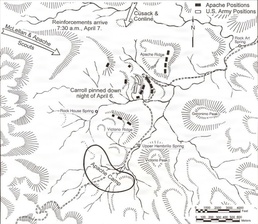
By Apr. 7, 1880, U.S. Army Apache Scouts had tracked the Mimbres (Warm Springs) Apache to the Hembrillo Basin in New Mexico. Despite their best efforts, the Army failed to capture Chief Victorio during the largest battle of Victorio’s War.
Chief Victorio had originally worked with the government to find suitable reservation lands for his people, but the relationship fell apart after the group was made to leave their preferred home on the Ojo Caliente (Warm Springs) Reservation in New Mexico to be co-located with other Apache tribes at the San Carlos Reservation in Arizona. Forced to live in poor conditions with rival tribes, the Mimbres Apache attempted multiple times to flee into the mountains and soon became known for their raiding of local settlements across the southwestern United States, as well as across the border in Mexico. Each time they fled, they were forcefully returned to the reservation by U.S. military and civil intervention.
In the late summer of 1879, the group attempted once more to return to Ojo Caliente but were rebuffed by the Department of Interior against the advice of military commanders. Victorio, now in his sixties, believed he would soon be arrested and left the reservation for the final time with 60–80 native warriors, their wives and children. He quickly made an enemy of the 9th Cavalry Regiment, local militias, and the Texas Rangers by attacking and raiding military posts and small towns in New Mexico and Texas.
In October, Maj. Albert P. Morrow, commander of the campaign in southern New Mexico, followed Victorio into northern Mexico. Morrow was accompanied by 2nd Lt. Charles B. Gatewood and his company of Apache Scouts out of Camp Apache, Arizona. Their efforts to trap Victorio failed, and once he returned to the U.S. in January 1880, he continued to evade capture and inflict casualties on the 9th Cavalry and local citizenry.
The U.S. Army’s Apache and Navajo Scouts played a crucial role in the campaign against Victorio. Not only were they pivotal in tracking the chief through difficult terrain across multiple states and two countries, they also helped cavalry units find fresh water and provisions, served as couriers, and participated in numerous skirmishes with Victorio’s warriors. By late March 1880, they had located Victorio’s camp in Hembrillo Basin in southern New Mexico (presently located within the White Sands Missile Range). His fighting force numbered approximately 150 warriors, augmented by men from other Apache tribes.
The Army quickly planned an ambush of the site. Col. Edward Hatch, 9th Cavalry commander, ordered his troops to encircle the camp along the San Andres Mountains that formed the western slope of Hembrillo Basin. On Apr. 5, Capt. Henry Carroll, commanding 2nd Battalion, sent small scout patrols along the canyon in the northeast to ascertain the location of Victorio’s force within the basin. The next day, the battalion moved further south into the canyon, reportedly looking for water, and was quickly surrounded by Victorio’s warriors.
Help for Carroll’s battalion did not arrive until the next morning, Apr. 7. Capt. Curwen B. McLellan’s detachment from the 6th Cavalry Regiment and approximately 150 Apache Scouts were approaching from the west when the scouts alerted McLellan to the ongoing battle. McLellan charged into the basin simultaneously with company commanders Lts. Patrick Cusack and John Conline, who had split from Carroll’s battalion the day before, and forced Victorio into retreat. An attempt to outflank the Apache along the ridge by two of McLellan’s scout companies failed to encircle the south-fleeing enemy. Despite being the largest battle of the conflict by number of combatants, cavalry commanders reported only two 9th Cavalry soldiers killed.
Colonel Hatch was approaching from the south with 1st Battalion for the planned assault the next day when the battle occurred. In a stroke of bad luck, he narrowly missed the retreating Apache and failed to capture their elusive chief. Victorio would remain a problem for U.S. Army elements until he was killed by Mexican forces during the Battle of Tres Castillos in October 1880.
Article by Erin E. Thompson, USAICoE Staff Historian. New issues of This Week in MI History are published each week. To report story errors, ask questions, request previous articles, or be added to our distribution list, please contact: TR-ICoE-Command-Historian@army.mil.