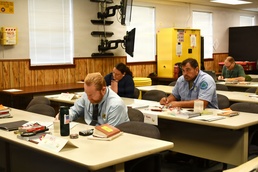
FORT POLK, La. — Being prepared for any emergency is the focus of Fort Polk’s Directorate of Plans, Training, Mobilization and Security and the Warrior Operations Center. Learning the skills necessary to successfully manage disasters when they strike is part of what they do.
During the last week of February members of DPTMS and the WOC took a Hazardous Waste Operations and Emergency Response training class presented by Directorate of Public Works - Environmental Management Support Services - Compliance Management Branch.
Terry Palmer, class facilitator, said one of the biggest obstacles in doing what’s right is the lack of knowledge, or “second guessing.”
“Being trained removes the guesswork; you see it, you fix it (if possible), you report it, and you learn from it,” Palmer said.
Mark Leslie, DPTMS director, took the class and said as the directorate responsible for managing a crisis on Fort Polk, he recognized that while his team has a large amount of training and real-world experience in just about every type of incident there is, what they didn’t have was a lot of experience and knowledge dealing with hazardous materials.
“HAZMAT is a real threat in this region with a lot of it moving on the railways, while not on the installation, it is in our local area. We have a great plan, our upcoming Full-Scale Exercise in June will be focused on a HAZMAT incident to validate this plan to best protect our community. This is always our number one priority,” Leslie said.
Planning for the exercise and absorbing that information is the reason they took the course. “As our instructor, Palmer related the material in a way that made it applicable to what we do, not only for an emergency, but in everyday life, Leslie said.
He said learning prevention and proper handling of dangerous chemicals in an emergency was one of the most important concerns. Second - training and education are key.
“You don’t know what you don’t know. I went into this class expecting to get a few “nuggets” to take away to use and apply in our exercise. What I left with was a healthy respect for HAZMAT and a comprehensive understanding of HAZMAT response and a new respect for the complexity of the HAZMAT world and those who work in it,” Leslie said.
Palmer said, from his perspective, teaching his students to be strategic about safety; understanding how to avoid risk and having the capacity to respond reflexively in a variety of situations were key concepts he wanted them to walk away from the class knowing.
Taking the information learned and relaying it into a more realistic exercise to provide a better training is part of the goal.
“Setting expectations for leaders in a HAZMAT response is key. The HAZMAT environment moves at a much slower pace due to its complexity, lethality and the precautions that must be taken to protect first responders. Situational awareness is going to be more progressive due to the methodical response that must be taken to prevent more casualties,” Leslie said. “This class also helped me take a real analytical look at our current plan and address potential capability gaps. This is very helpful. Nobody can do a HAZMAT response alone. In our Full-Scale Exercise in June, it will be a multi-agency response, installation, local, state and federal, plus, some private industry partners, all putting expertise together to protect people — our people. That’s a great thing.
Leslie said this was a great course that is only given two times a year and delivered very professionally.
“You leave with three different certifications. I highly encourage any of our civilians or uni-formed service members who work or perform in the HAZMAT, CBRNE, NBC or related fields to attend,” Leslie said.
Palmer said although the WOC members are not the individuals directly involved in the emergency, their decisions and coordination are critical in understanding the situation, anticipating the needs, and asking the correct questions.
“The better you understand the mission and roles of each responding team, the easier it is to identify gaps between the different organizations and correct them,” said Palmer.